
THOUGHTS INTO ACTION
Lou Marinoff, Professor of Philosophy at the City College of New York, USA, spoke to Common Knowledge about academia, philosophical counselling, and table hockey.
Did you always want to work in academia?
I enjoy the professorial role immensely. Lecturing is a wonderful way to refresh ideas, cultivate young minds, and shape thoughtful citizens. Other hats that professors are wont to wear – engaging in research and publication, conferencing with colleagues, speaking and consulting in one’s field, and performing public service – are equally rewarding in their variegated ways. Working in academia confers duties, privileges, and opportunities
alike. To me, the most delectable fruit of academe’s grove is the luxury of time for reading, contemplating, and writing, as well as indulging a hobby or two.
Interview with Scott Eberle in American Journal of Play (in English)


Welcome to Lou Marinoff’s website!
“the world’s greatest marketer of philosophical counseling”
New York Times Weekend Magazine
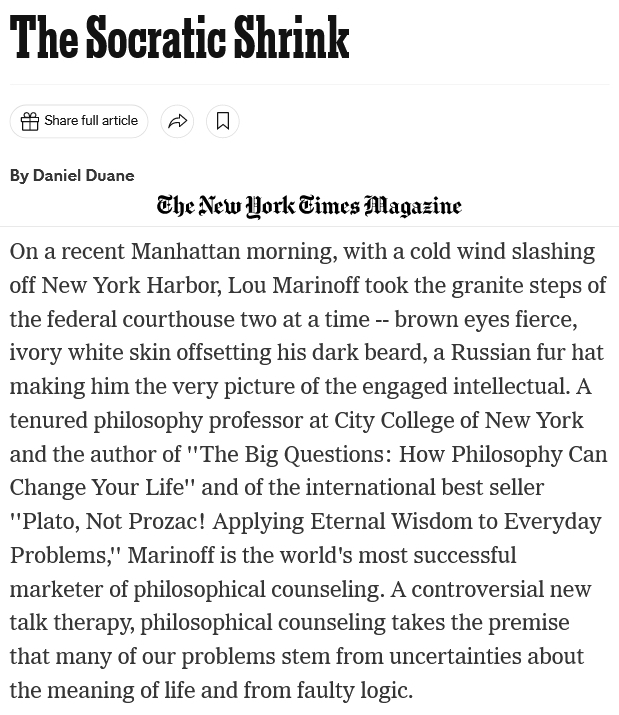
“a Renaissance man”
Europe’s Journal of Psychology
Academics
Lou is professor of Philosophy at the City College of New York.
» Academic Profile & Recent Publications
» Chartwell Speakers Profile
» Full Curriculum Vitae
Books
Lou has authored several internationally bestselling books, and has contributed many book chapters.
» Books
» Contributed Book Chapters
» APPA Journal
Books list
2022: Essays on Philosophy, Praxis and Culture, Anthem Press
2020: Therapy for the Sane, Waterside Productions Inc.
2020: The Middle Way, Waterside Productions Inc.
2019: On Human Conflict: The Philosophical Foundations of War and Peace, Rowman & Littlefield, Lanham, MD
2018: Eloquent Sinking: A Gaspesian Tragicomedy, Waterside Press, Dan Diego
2014: The Power of Dao: Finding Serenity in Changing Times, Argo-Navis (Perseus Books), Denver. New edition by Waterside Press, San Diego, 2017. Translated into 6 languages
2012: The Inner Philosopher: Conversations on Philosophy’s Transformative Power. A dialogue with Daisaku Ikeda. Cambridge, MA: Dialogue Path Press. Translated into 6 languages
2007: The Middle Way: Finding Happiness in a World of Extremes, Sterling, New York & London.
Translated into 5 languages.
2003: Therapy for the Sane: How Philosophy Can Change Your Life, Bloomsbury, New York & London.
Translated into 13 languages.
2001: Philosophical Practice, Academic Press, NY.
1999: Plato Not Prozac: Applying Philosophy to Everyday Problems, HarperCollins, NY.
Translated into 27 languages.
Publication de la traduction en français en 2000
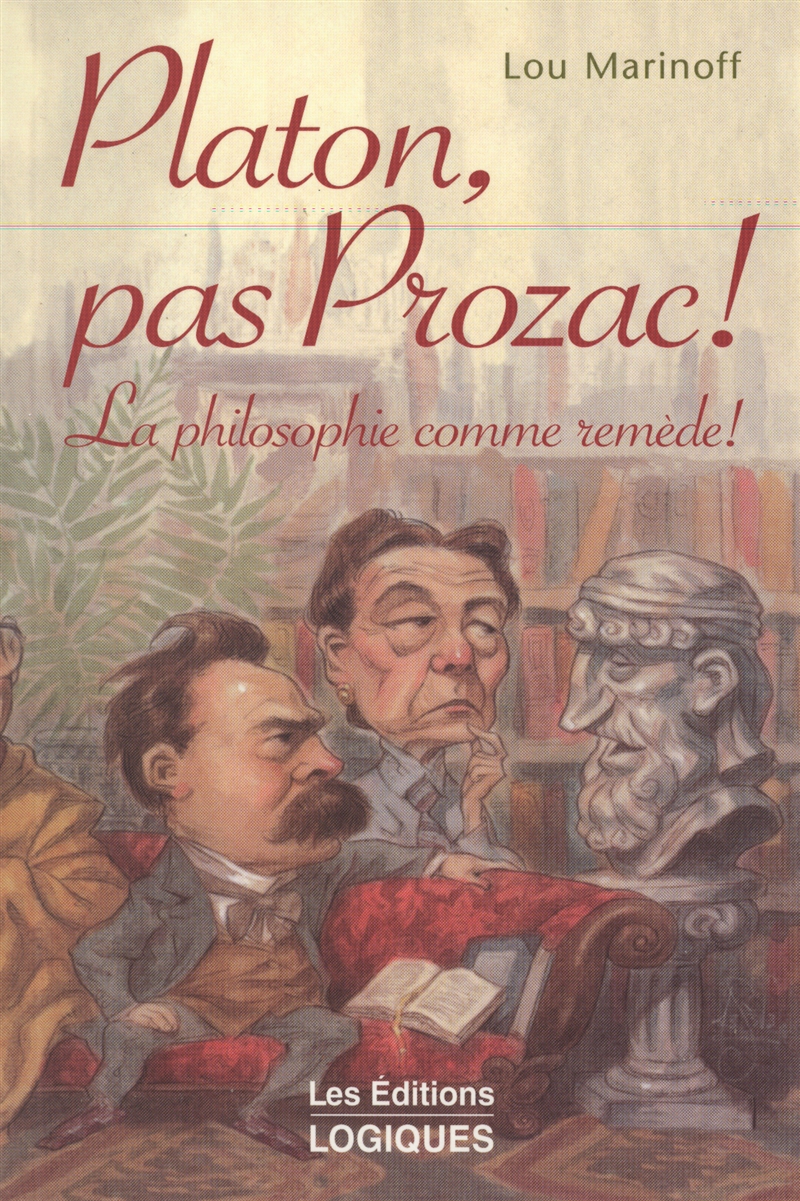
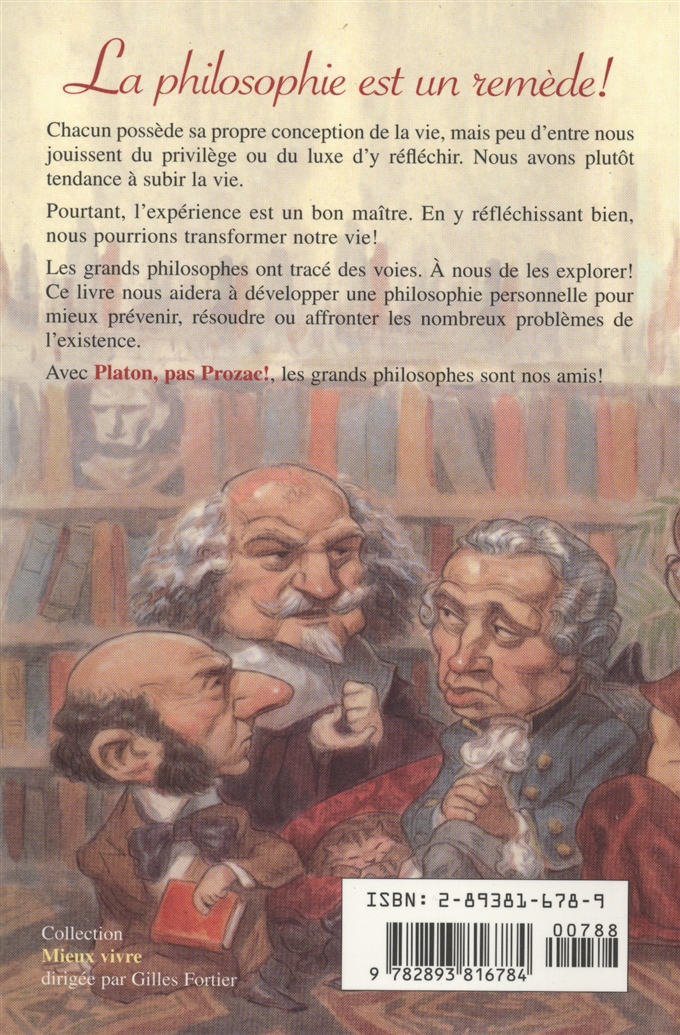
Chacun possède sa propre conception de la vie, mais peu d’entre nous jouissent du privilège ou du luxe d’y réfléchir. Nous avons plutôt tendance à subir la vie.
Pourtant, l’expérience est un bon maître. En y réfléchissant bien, nous pourrions transformer notre vie !
Les grands philosophes ont tracé des voies. Un nous de les explorer. Ce livre nous aide à développer une philosophie personnelle pour mieux prévenir, résoudre ou affronter les nombreux problèmes de l’existence.
Avec Platon, pas Prozac !, les grands philosophes sont nos amis !
1994: Fair New World, Backlash Books, Vancouver.
Worldwide Services
» Philosophical Counseling
» Events for Groups/Organizations
» Leadership Events
» Speaking and Book Events
to book a keynote speech, please email Raleigh Addington at
Chartwell Worldwide Speakers Bureau
APPA
Lou is founding president of the American Philosophical Practitioners Association, and founding editor of its Journal, Philosophical Practice.
https://appa.edu

Traduit avec DeepL de l’anglais au français
Lou Marinoff est un universitaire, auteur et chercheur du Commonwealth né au Canada. Il est professeur de philosophie et d’études asiatiques au City College de New York[1] et président fondateur de l’American Philosophical Practitioners Association[2].
Éducation
Marinoff a étudié la physique théorique à l’Université Concordia et à l’Université McGill avant d’obtenir un doctorat en philosophie des sciences à l’University College London[2]. Il s’est ensuite rendu à l’Université hébraïque de Jérusalem pour un travail post-doctoral[3], puis a été chargé de cours à l’Université de Colombie-Britannique[2].
Carrière
En 1994, il rejoint le City College of New York où il est actuellement professeur de philosophie et d’études asiatiques[2]. Il a également été président et directeur exécutif de l’American Society for Philosophy Counseling and Psychotherapy. Il a cofondé l’American Philosophical Practitioners Association en 1998[4] et est le rédacteur en chef de son journal, Philosophical Practice[2][5].
Marinoff a également collaboré avec des instituts et des forums tels que l’Institut Aspen, Biovision, le Festival des penseurs, Horasis, l’Institut pour le gouvernement local de l’université d’Arizona, Soka Gakkai International, le Strategic Foresight Group et le Forum économique mondial[2].
Hockey sur table
Marinoff a été trois fois champion de hockey sur table de l’Open du Canada (1978, 79, 80) et champion de l’US Open (2015)[2].
RÉFÉRENCES
- Faculty and Staff Profiles: Lou Marinoff. City College of New York. Accessed April 2019.
- « Lou Marinoff | The City College of New York ». http://www.ccny.cuny.edu. Retrieved January 19, 2021.
- « The Socratic Shrink – NYTimes.com ». The New York Times. May 28, 2015. Archived from the original on May 28, 2015. Retrieved January 19, 2021.
- Daniel Duane (March 21, 2004). The Socratic Shrink. The New York Times Magazine. Archived May 28, 2015.
- Duane, Daniel (March 21, 2004). « The Socratic Shrink (Published 2004) ». The New York Times. ISSN 0362-4331. Retrieved January 19, 2021.
CONTEMPORARY PHILOSOPHICAL PRACTICE:FORCES THAT FAVOR, AND HINDER, ITS PROGRESS
LA PRATIQUE PHILOSOPHIQUE CONTEMPORAINE : LES FORCES QUI FAVORISENT ET ENTRAVENT SON ÉVOLUTION
LOU MARINOFF
This article is adapted from my acceptance speech for the Doctor Honoris Causa, conferred
by the West University of Timisoara, Romania, on April 23, 2019.
Abstract
During the past several decades, philosophical practice has emerged as a viable and global movement of philosophers, who – notwithstanding the many methods, styles, and schools that have evolved – share the premise that philosophy has applicability to and indeed utility for addressing and resolving numerous problems that arise in the daily lives of individuals, groups, and organizations. A constellation of favorable forces has abetted the emergence of philosophical practice, but likewise another constellation of opposing forces has obstructed its progress. The aim of this article is to identify and analyze ten of the more prominent features of both constellations. As we shall see, in many instances these features are actually Janus-like; that is, they look in both directions at once, simultaneously helping and hindering.
CONCLUSIONS
In sum, philosophical practice is more relevant and necessary than everbefore, and in every sector of society. As I have maintained from the outset,credible philosophical practitioners must be trained in the academy, as are credible practitioners of every other profession. And indeed, a small but pioneering vanguard of universities, from several European and Asian countries, are nowoffering graduate programs in this nascent field. I salute West University of Timisoara for joining this historic and timely vanguard. It may surprise you, or not, to learn that not one single American university has yet established even an M.A.Program in Philosophical Practice. Although at least one such formal proposal wasresoundingly approved at all academic levels, it was placed in an administratively induced coma by a once-storied institution now sadly committed to furtheringculturally-induced illnesses, instead of their prevention and cure.30
______
30 The City College of New York (CCNY) twice approved a proposed M.A. Program in
Philosophical Practice at every governance level, including by its Provost and President, only to see the proposal buried in administrative “red tape” by the inaccessible Chancellor’s office of the City University of New York (CUNY), of which the formerly free-standing and storied City College (CCNY) has been a mere appendage since the 1960s
Lire cet article
Why Lou Marinoff’s PEACE method is a key innovation when applied to corporate settings
Aleksandar Fatic, Behavioral Philosopher, Professor and Author
A leading American practical philosopher Lou Marinoff conceived the counseling and consultancy method with the acronym PEACE (this method should not be confused with the one with the identical acronym, which is a technique of questioning adopted from the police and military, and applied to HR work in large corporations today). Marinoff’s method contains a definition of the problem (P), elaboration of the problem (E), formulation of potential alternative solutions (A), contemplation (C), and the achievement of equilibrium (E). The first three phases are relatively familiar from various decision-making technologies, however the last two highlight a key feature of decision making that in our rationalist age we are often inclined to forget, yet ones which determine the effectiveness of our acting on our decision in both our private and our organizational, institutional or corporate lives.

REPORT OF THE COURSE ON PHILOSOPHICAL COUNSELLING WITH AMERICAN PHILOSOPHICAL PRACTITIONERS ASSOCIATION
Madhulika Sharma – Vikas Baniwal – Ashwini Mokashi – Charu Thapliyal – Mitali Bhagabati – Sudeep Raj Kumar
This is a report of the course on Philosophical Counseling with American Philosophical Practitioners Association which encompasses the summaries of the course of study and training alongside individual group sessions with different expertise from the field.
Philosophy – the quintessential component of knowledge, which discusses the fundamental questions such as ‘what is knowledge?’, ‘how is it acquired?’ and ‘what is to be done with it?’ – is unfortunately missing from the public epistemologies. It is paradoxical that though the quest for knowledge in its new forms and perspectives is increasing constantly, something that is foundational to all forms and perspectives of knowledge is being neglected to the core. Something that contributed to this state of affairs, at least indirectly, is the way in which Philosophy is being reduced to the academic world with its basic forms of teaching and research. What is required at this juncture is taking philosophy beyond academia into the public epistemologies in a convincing way.
There are different existent ways of applying philosophical knowledge that are being innovated, which include, but are not limited to, Philosophy Cafes, Philo dramas etc. One such significant endeavor is Philosophical Counseling which attempts to support those who need a philosopher to address their concerns. It is often placed antagonistic to Psychological and other forms of counselling which is not true. Philosophical counselling moves along with other disciplines in their practices – by sharing and accepting the expertise wherever it is useful. However, it also demarcates its uniqueness by addressing the human concerns that are exclusive to its domain. Though every discipline in one way or the other is developed to address a particular human concern, no single discipline can claim to be capable of addressing all the concerns of human life. For instance, Psychological Counseling addresses certain issues of human concern such as depression and anxiety, whereas Philosophical Counseling addresses existential human concerns that are unique to Philosophy. The difference also lies in the fact that philosophical concerns are much deeper, more pervasive and universal than the concerns of other disciplines.
The practitioners of Psychological Counseling are well-suited for treating mental illnesses, but while that is a great need for the society, it is also necessary for dealing with various levels of confusion among the minds of people. Strengthening their mental health and making sure that they do not fall in the clutches of mental illnesses is a job that philosophers are well suited for. If we want to keep people productive, sane, at peace and out of trouble, philosophers can help in a big way by applying philosophical wisdom to those, who think they can benefit by the philosophical understanding. Applied philosophy is best practiced by students/teachers of philosophy, who have reached a certain depth of understanding philosophical or wisdom principles.
Source : Academia.edu Publishing.
VIDÉOS
AUTRES LIENS IMPORTANTS
Global Thinkers Forum
Encyclopedia.com
Ducere Global Business School
CHARTWELL SPEAKERS
Page LinkedIn
Page Facebook
Page Google Scholar
Page YouTube
Page Google Play
Page Academia.edu
Page 17th International Conference on Philosophical Practice
All American Speakers Bureau
The PhilPapers Foundation
Rationally Speaking Podcast
Why Lou Marinoff’s PEACE method is a key innovation when applied to corporate settings
Why is the definition of the problem in decision-making technologies so difficult? The PEACE method.


 Observatoire des nouvelles pratiques philosophiques