Publié en ligne par Cambridge University Press, 19 August 2025
Xiaojun Ding, Jiayi Xin, Peter Harteloh, Caifeng Xie, Sirui Fu and Minqiang Xu
Ding X, Xin J, Harteloh P, Xie C, Fu S, Xu M. From Academia to Action: Philosophical Practice as an Emerging Profession and Paradigm in Contemporary Society.
Creative Commons
Il s’agit d’un article en libre accès distribué sous les termes de la licence Creative Commons CC BY, qui permet l’utilisation, la distribution et la reproduction sans restriction sur n’importe quel support, à condition que l’œuvre originale soit correctement citée.
Vous n’êtes pas tenu d’obtenir une autorisation pour réutiliser cet article.
__________
This is an open access article distributed under the terms of the Creative Commons CC BY license, which permits unrestricted use, distribution, and reproduction in any medium, provided the original work is properly cited.
You are not required to obtain permission to reuse this article.
TRADUCTION DU TEXTE ORIGINAL DE L’ANGLAIS AU FRANÇAIS
English speakers :
Click here to access the original version in English
Du monde universitaire à l’action : la pratique philosophique, une profession et un paradigme émergent dans la société contemporaine
| Nom de l’auteur | Affiliation |
|---|---|
| Xiaojun Ding | Department of Philosophy, School of Humanities and Social Science, Xi’an Jiaotong University, Xi’an, Chine |
| Jiayi Xin | Department of Philosophy, School of Humanities and Social Science, Xi’an Jiaotong University, Xi’an, Chine |
| Peter Harteloh | Erasmus Institute for Philosophical Practice, Rotterdam, Pays-Bas |
| Caifeng Xie | Department of Philosophy, School of Humanities and Social Science, Xi’an Jiaotong University, Xi’an, Chine |
| Sirui Fu | Department of Philosophy, School of Humanities and Social Science, Xi’an Jiaotong University, Xi’an, Chine |
| Minqiang Xu | Department of Philosophy, School of Humanities and Social Science, Xi’an Jiaotong University, Xi’an, Chine |
| Date de publication : Publié en ligne par Cambridge University Press : 19 août 2025 | |
| Corresponding author: Xiaojun Ding; Email: xiaojunding@xjtu.edu.cn | |
Résumé
La pratique philosophique a émergé en tant que discipline transformative qui fait le lien entre la recherche théorique et la vie quotidienne. Apparu à la fin du XXe siècle, ce domaine intègre le conseil, la thérapie et d’autres applications pratiques des perspectives philosophiques permettant de répondre aux défis existentiels et pragmatiques auxquels sont confrontés les individus, les groupes et les organisations dans la société contemporaine. Cet article examine la définition, l’évolution historique, les bases théoriques et les méthodologies de la pratique philosophique, tout en discutant des perspectives de professionnalisation — y compris la certification, les directives éthiques et l’intégration au sein des systèmes de santé et d’éducation. En fin de compte, cette étude souligne le potentiel de la pratique philosophique à revitaliser la pertinence de la philosophie, à favoriser l’épanouissement personnel et à améliorer le bien-être de la société.
Sommaire
1. Introduction
Dans un monde caractérisé par des changements rapides, la diversité culturelle et des dilemmes éthiques complexes, les individus recherchent de plus en plus des repères pour faire face aux défis personnels et existentiels. La philosophie académique traditionnelle, souvent perçue comme abstraite et déconnectée des préoccupations quotidiennes, a eu du mal à répondre à ces besoins immédiats. En réponse, un mouvement connu sous le nom de « pratique philosophique » a vu le jour, visant à combler le fossé entre la théorie philosophique et la vie quotidienne. Si l’éthique, la philosophie sociale et la philosophie politique telles qu’enseignées à l’université peuvent être considérées comme des applications pratiques (voir Aristote, 2011), la pratique philosophique s’étend au-delà de ces domaines. Aujourd’hui, nous distinguons la philosophie théorique (ontologie, épistémologie, etc.), la philosophie pratique (éthique, philosophie sociale, etc.) et la pratique philosophique. La pratique philosophique implique l’application de méthodes et de perspectives philosophiques pour aider les individus à examiner leurs croyances, à améliorer leurs schémas de pensée et à résoudre des problèmes pratiques ou existentiels. Elle représente un glissement du paradigme traditionnel de la « philosophie de salon » vers une approche plus engagée et accessible qui intègre la philosophie dans la vie quotidienne.
Née en Europe et en Amérique du Nord à la fin du XXe siècle, la pratique philosophique englobe le conseil et la thérapie philosophiques, l’animation de groupes, le conseil en organisation et la philosophie avec les enfants, etc. Des philosophes pionniers tels que Gerd B. Achenbach, Lou Marinoff, Peter B. Raabe, Oscar Brenifier et Ran Lahav ont joué un rôle déterminant dans l’établissement de ce domaine en tant que profession et paradigme distincts. Ce mouvement reflète un mécontentement croissant face aux limites de la philosophie académique traditionnelle et cherche à redynamiser la pertinence de la philosophie en répondant directement aux préoccupations des individus et des sociétés modernes, se présentant souvent comme une alternative ou un complément à la psychothérapie.
Cet article examine l’histoire, les fondements théoriques et les méthodologies pratiques de la pratique philosophique, en soulignant son évolution vers un nouveau paradigme. La revue de la littérature offre un aperçu complet des recherches existantes et des fondements théoriques pertinents pour la pratique philosophique. Elle explore les diverses formes et méthodes employées par les praticiens de la philosophie, la relation entre le conseil philosophique et la psychothérapie, ainsi que les efforts de la profession en matière de certification et de normes éthiques. En outre, l’article aborde l’avenir de la pratique philosophique, en considérant son potentiel à devenir partie intégrante de la vie publique et du marché, ainsi que son rôle dans la transformation de la philosophie en une discipline plus inclusive et plus pratique. En analysant le développement et l’état actuel de la pratique philosophique, cette étude vise à fournir des éclairages sur son importance en tant que profession en plein essor et sur son potentiel à influencer à la fois la recherche philosophique et le bien-être de la société.
2. Définir la pratique philosophique : jeter un pont entre la théorie et la vie quotidienne
Selon Abraham Maslow (réf. Maslow 1981), le but ultime de l’existence humaine est l’épanouissement personnel et la plénitude — une aspiration à une vie meilleure. Si la théorie de Maslow sur la hiérarchie des besoins est largement reconnue, son applicabilité varie d’une culture à l’autre. Les recherches démontrent que, bien que les besoins physiologiques et de sécurité fondamentaux soient universels, l’importance accordée aux besoins de niveau supérieur, tels que l’estime et l’épanouissement personnel, diffère considérablement d’une culture à l’autre. Dans les sociétés individualistes, l’épanouissement personnel est souvent considéré comme l’objectif primordial, tandis que les cultures collectivistes peuvent privilégier la communauté et la famille plutôt que l’épanouissement individuel (Hofstede, référence Hofstede2001 ; Nevis, référence Nevis1983). Par conséquent, la théorie de Maslow est valable dans toutes les cultures, mais se manifeste à des degrés divers et par des voies différentes.
Cependant, dans un monde caractérisé par la diversité des cultures et des valeurs, la coexistence d’idéologies différentes crée un labyrinthe de confusion, conduisant à de profonds conflits dans les relations personnelles et à des tourments intérieurs. Par exemple, la mondialisation a intensifié les interactions entre les cultures, entraînant parfois des crises d’identité ou des chocs culturels (Berry, référence Berry 2005). L’essor des réseaux sociaux a amplifié l’exposition à des valeurs contradictoires, amenant les individus à se débattre avec des questions sur le relativisme moral et les normes éthiques (Turkle, référence Turkle2011). Ces conflits sont souvent perçus comme des maladies psychologiques ou des défaillances morales préjudiciables à l’humanité. À mesure que les problèmes psychologiques s’aggravent, les individus remettent de plus en plus en question le monde et la société, mais peinent à trouver des réponses définitives.
2.1 L’émergence de la pratique philosophique
La pratique philosophique apparaît comme un moyen de relever ces défis, offrant une voie vers la réalisation de soi en aidant les individus à explorer des questions fondamentales sur l’existence, le sens et les valeurs. En s’engageant dans une réflexion philosophique, les personnes peuvent clarifier leurs convictions, surmonter la confusion et parvenir à une compréhension plus profonde d’elles-mêmes et du monde — progressant ainsi vers la réalisation de soi décrite par Maslow. Grâce à la pratique philosophique, les individus peuvent atteindre la paix intérieure et l’épanouissement en alignant leurs actions sur leur moi authentique.
En tant que représentantes du tournant appliqué de la philosophie occidentale contemporaine, le conseil et la thérapie philosophiques, ainsi que diverses approches intégrant la philosophie dans la vie quotidienne, sont collectivement désignées sous le nom de « pratique philosophique ». La pratique philosophique consiste à intégrer la philosophie dans la vie quotidienne des gens, généralement sous la conduite d’un praticien philosophique formé qui utilise des méthodes philosophiques — telles que des théories et des techniques philosophiques — pour examiner les croyances des individus et améliorer leurs schémas de pensée grâce à une réflexion sur leurs propres expériences. Ce processus aide les participants à apprendre à penser comme des philosophes, ce qui les aide à résoudre les problèmes pratiques ou les questions existentielles qu’ils rencontrent dans la vie quotidienne. En fin de compte, la pratique philosophique conduit à une meilleure compréhension de soi, à un épanouissement personnel et à la paix intérieure.
En ce qui concerne l’émergence de la pratique philosophique contemporaine, ses débuts dépendent fortement de la manière dont on définit le terme. Lorsqu’elle est comprise au sens strict comme des consultations individuelles destinées à remplacer la psychothérapie traditionnelle, la pratique philosophique remonte souvent à ses débuts en Europe à la fin du XXe siècle (Achenbach et al., 1984). Dans ce contexte, les méthodes mettent l’accent sur le dialogue individuel utilisant des techniques philosophiques classiques pour aborder des questions personnelles et existentielles dans un cabinet privé en dehors du milieu universitaire. Bien que certains chercheurs aient attribué les origines de la pratique philosophique aux États-Unis à l’affirmation selon laquelle Peter Grimes aurait été l’un des premiers pionniers dans ce domaine, les preuves sont ambiguës. Grimes est principalement connu pour son travail universitaire — enseignant le dialogue socratique en milieu universitaire et animant des séances de groupe (par exemple, avec des personnes aux prises avec une addiction) — mais il existe peu de preuves étayant l’existence d’une pratique soutenue au-delà de ces frontières institutionnelles (Grimes & Uliana, référence Grimes et Uliana 1998). De plus, l’intégration de la réflexion philosophique dans des contextes psychothérapeutiques peut être considérée comme l’un des précurseurs à partir desquels les consultations philosophiques contemporaines ont ensuite évolué (Cohen, référence Cohen 2003a ; Rogers, référence Rogers 1951).
Élargir le champ d’application pour y inclure le dialogue socratique en groupe repousse la perspective historique encore plus loin, au début du XXe siècle. Des pionniers tels que Leonard Nelson et Gustav Heckmann ont joué un rôle déterminant dans le développement de ces pratiques en Allemagne, où ils ont animé des séances avec des ouvriers et d’autres groupes non universitaires. Leur travail a non seulement démocratisé le dialogue philosophique, mais a également posé les techniques fondamentales pour impliquer des publics diversifiés en dehors des cadres universitaires formels (Heckmann, Référence Heckmann1981 ; Nelson, Référence Nelson1949). Cette tradition ancienne souligne la possibilité d’une pratique philosophique en tant qu’activité publique et socialement engagée, plutôt que confinée aux murs de l’université.
Si l’on adopte une conception plus large de la pratique philosophique — en tant qu’« art de vivre » qui met l’accent sur la philosophie comme mode de vie —, ses origines deviennent encore plus anciennes et transculturelles (Ding et al., Référence Ding, Harteloh, Pan et Yu2024b). Dans ce sens large, la philosophie a longtemps servi à la fois de guide pour la vie quotidienne et de source de conseils éthiques et thérapeutiques. Pierre Hadot (Hadot, 1995) souligne que la philosophie n’est pas simplement une entreprise intellectuelle, mais un mode de vie qui implique une introspection continue et un engagement actif avec le monde, une perspective évidente dans les dialogues classiques de Socrate et dans les pratiques des stoïciens, tels qu’Épictète et Marc Aurèle, qui cultivaient la sérénité et la résilience à travers leur mode de vie. De même, de la Grèce antique à Rome, en passant par l’Inde et la Chine, les philosophes se livraient à des dialogues consultatifs et thérapeutiques. En Chine, par exemple, Confucius ne se contentait pas de débattre de conduite éthique et personnelle avec ses disciples et les dirigeants, mais prônait également l’harmonie sociale et la vertu (Ames & Rosemont, référence Ames et Rosemont 1998 ; Zhang, référence Zhang 1999). Bien que la philosophie occidentale se soit souvent limitée à l’exploration théorique et à l’analyse conceptuelle rigoureuse depuis l’époque de Platon, la notion universelle de la philosophie en tant qu’art de vivre intégratif — transcendant les frontières culturelles et temporelles — reste un paradigme intemporel et influent.
Si la « philosophie de salon » a bâti un vaste empire intellectuel grâce au raisonnement systématique et à la spéculation abstraite, son éloignement du grand public et de la vie quotidienne a suscité le mécontentement de nombreuses personnes. La pratique philosophique est née de ce mécontentement vis-à-vis de la philosophie académique traditionnelle, proposant que la philosophie se tourne vers la vie quotidienne et aborde des préoccupations concrètes. Comme le note Hadot, l’émergence des universités a également contribué au mode de fonctionnement actuel de la philosophie. À l’origine, la philosophie était un phénomène public, Socrate engageant le dialogue avec les gens sur la place du marché. Puis, des écoles ont vu le jour, telles que l’Académie de Platon et l’école stoïcienne, et la philosophie a fini par s’enfermer dans les universités (par exemple, l’université de Bologne, fondée en 1088, a reçu sa charte officielle (Authentica Habita) de l’empereur Frédéric Ier Barberousse en 1158), devenant ainsi une branche de la science. Aujourd’hui, on assiste à une redécouverte de la philosophie en tant que phénomène public.
2.2 Différents modes de pratique philosophique
En fonction de ses objectifs et de ses méthodes, la pratique philosophique se divise principalement en trois catégories : l’accompagnement individuel ou les consultations, l’animation de groupes (y compris la philosophie avec les enfants en milieu scolaire) et le conseil aux organisations. Il est important de faire la distinction entre la pratique philosophique et les consultations philosophiques. La « pratique philosophique » désigne la philosophie en tant que mode de vie, englobant une approche globale visant à intégrer la philosophie dans la vie quotidienne. Les « consultations philosophiques » sont des activités spécifiques au sein de cette pratique, impliquant un engagement direct avec les clients pour aborder des questions personnelles ou organisationnelles. De même, il existe une distinction entre le conseil philosophique et les consultations philosophiques. Le terme « conseil » a des connotations psychothérapeutiques et est utilisé dans le cadre de la pratique philosophique ; cependant, le terme « consultation » peut être préféré pour souligner la nature philosophique de l’engagement sans impliquer de psychothérapie. Les consultations individuelles, le dialogue de groupe et le conseil organisationnel soutiennent tous la philosophie en tant que mode de vie.
2.2.1 Accompagnement/consultation individuels
Les clients qui sollicitent un accompagnement ou une consultation individuels s’adressent généralement à des praticiens de la philosophie avec des problèmes pratiques ou des dilemmes spécifiques, en quête d’aide. Historiquement, lorsque les individus étaient confrontés à des difficultés dans la vie, ils se tournaient souvent vers des psychologues ou des membres du clergé pour obtenir des conseils et des orientations. Cependant, en raison de problèmes tels que la durée prolongée des traitements, leur efficacité lente, le recours aux médicaments, l’étiquetage des individus en tant que « patients » et la tendance à la réapparition des symptômes en psychothérapie, certains psychologues — notamment Albert Ellis — se sont tournés vers la philosophie comme complément ou alternative à la psychothérapie. Ellis a développé la thérapie cognitive en psychologie et a créé la thérapie comportementale et émotionnelle rationnelle, intégrant des principes philosophiques dans la pratique psychologique (Ellis & Harper, 1997 ; Ellis & MacLaren, 2005).
Tous les problèmes que les gens rencontrent dans la vie quotidienne ne découlent pas de troubles psychologiques ou mentaux. En particulier pour les individus modernes dans ce monde complexe et en constante évolution, les gens sont souvent confrontés à diverses confusions et dilemmes existentiels plutôt qu’à des troubles neurobiologiques identifiés en psychopathologie. Si les problèmes d’une personne peuvent être résolus en examinant, diagnostiquant et ajustant soigneusement ses philosophies de vie fondamentales — telles que sa vision du monde, sa conception de la vie et ses valeurs —, il est alors plus approprié de consulter un conseiller en philosophie plutôt que de s’adresser à un psychiatre qui traite principalement par des médicaments (Harteloh, Référence Harteloh2013c). À l’inverse, si une personne souffre d’un dysfonctionnement émotionnel ou d’une maladie physiologique, une consultation médicale et un éventuel traitement pharmacologique sont nécessaires. Néanmoins, même pour les patients qui ont besoin de médicaments, l’intervention de la philosophie peut grandement faciliter leur traitement. Cette synergie entre la philosophie et la médecine souligne l’essor actuel des sciences humaines médicales. Lorsque les pensées des gens sont clarifiées, leur perception du monde devient plus claire, et leurs souffrances et luttes intérieures s’atténuent. Des recherches ont montré que le soulagement de la détresse mentale peut entraîner une réduction de la douleur physique, car on sait que le stress psychologique et les émotions négatives exacerbent les symptômes physiques (Gatchel et al., référence Gatchel, Peng, Peters, Fuchs et Turk2007 ; Lumley et al., référence Lumley, Schubiner, Lockhart, Kidwell, Harte, Clauw et Williams2017). En abordant la souffrance mentale par la pratique philosophique, les individus peuvent constater une amélioration de leur bien-être physique. C’est pourquoi Marinoff, président fondateur de l’American Philosophical Practitioners Association (APPA), qualifie le conseil philosophique de « thérapie pour les personnes saines d’esprit » (Marinoff, 2004).
Dans les régions fortement industrialisées — telles que les États-Unis, le Japon, la Chine, l’Inde et l’Europe —, les préoccupations existentielles sont omniprésentes et sont souvent médicalisées sous le diagnostic de dépression. En revanche, les pratiques philosophiques offrent un cadre alternatif en renouant avec la forme philosophique fondamentale. Ces pratiques permettent une transformation dans laquelle les individus passent du simple fait de remplir des rôles tels qu’étudiant, manager ou personne au foyer à s’engager de manière authentique en tant qu’apprenant, travailleur ou amoureux — passant ainsi du simple fonctionnement à une véritable existence (Harteloh, Référence Harteloh2024).
2.2.2 Animation de groupe
La pratique philosophique peut se dérouler en tête-à-tête ou en groupe — cette dernière étant connue sous le nom d’« animation de groupe », une forme de pratique philosophique impliquant plusieurs participants. Les séances informelles d’animation de groupe se tiennent généralement dans des cafés, des bars et des librairies. Au début du développement de la pratique philosophique, notamment en France, les lieux publics tels que les cafés ont joué un rôle crucial dans la facilitation du dialogue et des échanges entre les praticiens de la philosophie et le grand public (Sautet, Référence Sautet1995). Les gens se réunissaient régulièrement pour participer à des discussions animées par un praticien de la philosophie. Les thèmes de discussion pouvaient être prédéterminés ou décidés sur place par consultation ou vote parmi les participants. Ces sujets, qui intéressent tout le monde et sont ouverts à la discussion, peuvent être par exemple : « La liberté consiste-t-elle à agir selon sa propre volonté ? » ou « Dans quelles circonstances le mensonge n’est-il pas condamnable ? ». En raison de la diversité des parcours universitaires et professionnels des participants, leurs points de vue divergent souvent. Même si aucun consensus n’est atteint à la fin de la discussion, le processus fait appel à une réflexion indépendante et critique, atteignant ainsi l’objectif de la pratique philosophique qui est de cultiver la pensée.
L’animation formelle de groupe suit des procédures relativement fixes, la méthode principale étant la méthode socratique nelsonienne (Heckmann, référence Heckmann 1981 ; Nelson, référence Nelson 1949), qui a ensuite été développée et affinée pour devenir ce que l’on appelle aujourd’hui le dialogue « néo-socratique ». Le groupe participant à la pratique se compose généralement d’une dizaine de personnes, qui peuvent être des étudiants, des personnes au foyer, des employés d’entreprise ou des fonctionnaires, sans qu’aucune formation philosophique préalable ne soit requise. Le praticien en philosophie n’a pas besoin de s’exprimer beaucoup tout au long du processus ni d’exprimer des points de vue personnels, mais sert principalement à guider le déroulement de la discussion. La méthode passe d’une question, via des exemples, à des principes sous-jacents. Ces principes ne sont pas de nature générale ou théorique, mais sont valables pour le groupe impliqué dans le processus. L’animation formelle de groupe se déroule généralement dans un espace relativement clos et calme, tel qu’une salle de classe ou une salle de conférence, mais a parfois lieu dans des bibliothèques ou des librairies. Contrairement à l’animation informelle de groupe, l’animation formelle de groupe vise en fin de compte à parvenir à une réponse concluante valable pour le groupe de participants, de sorte que les discussions peuvent durer plusieurs jours.
Il convient de noter que la méthode socratique nelsonienne peut également s’appliquer à des consultations individuelles — par exemple, par le praticien de philosophie français Oscar Brenifier. Une question constitue à la fois l’entrée et la sortie de la consultation. Le processus de consultation socratique part de la question initiale du client, passe par une analyse d’exemples tirés de l’expérience, pour aboutir à une autre question philosophique illustrant les principes sous-jacents ou les présupposés du client.
2.2.3 Conseil en organisation
Toute organisation — qu’il s’agisse d’une administration, d’une école, d’un hôpital ou d’une entreprise — est confrontée à divers dilemmes éthiques et moraux. Le conseil en organisation désigne le processus par lequel des praticiens de la philosophie utilisent une série de techniques philosophiques pour renforcer ou améliorer la sensibilité éthique et l’éthique spirituelle de l’organisation (Ha?egan, référence Ha?egan2019a). Le philosophe économique néerlandais Henk van Luijk soutient que partout où il y a des affaires, il y a des crises morales. Une organisation éthique peut offrir à ses employés un environnement de travail plus positif et favoriser des relations collégiales plus harmonieuses, améliorant ainsi les relations entre les employés et les clients. Par conséquent, ce type de conseil en organisation est bénéfique pour tous et permet en fin de compte d’atteindre l’objectif de maximisation des intérêts de l’organisation (van Luijk, référence van Luijk1993). Les praticiens de la philosophie peuvent faire partie de l’organisation ou agir en tant que consultants externes facilitant des discussions de groupe au sein de l’entreprise, telles que des délibérations morales ou des promenades philosophiques.
Aux Pays-Bas, la méthode socratique nelsonienne et le dialogue néo-socratique qui en découle sont fondamentaux pour la philosophie d’entreprise. Ils sont appliqués dans des domaines tels que l’élaboration des politiques et l’identité d’entreprise, la promotion du bien-être humain au sein des entreprises (souvent désigné sous le terme de « ressources humaines »), la gestion de la qualité et l’éthique environnementale. En s’engageant dans un dialogue réflexif et critique, les praticiens explorent les valeurs et les hypothèses profondes qui sous-tendent les pratiques organisationnelles, ce qui aide les entreprises à résoudre des dilemmes éthiques, à améliorer la prise de décision et à favoriser une approche plus durable et centrée sur l’humain de la gouvernance d’entreprise.
Les praticiens de la philosophie peuvent également intégrer des techniques de conseil individuel et d’animation de groupe pour résoudre des problèmes organisationnels et interpersonnels spécifiques. Marinoff, s’appuyant sur ses années d’expérience dans la pratique philosophique, a développé le célèbre modèle de processus « PEACE » (voir figure 1), permettant à ce modèle de pratique philosophique — avec des organisations et des individus comme clients — de se répandre avec succès de l’Amérique du Nord vers l’Europe et le reste du monde. La méthode PEACE comprend les cinq étapes suivantes (Marinoff, référence Marinoff1999, pp. 37–51) :
Problème (P) : Identifier correctement les problèmes fondamentaux.
Émotion (E) : Exprimer de manière constructive les réactions émotionnelles du client face aux problèmes, afin de permettre la poursuite de la discussion.
Analyse (A) : Aider à résoudre les problèmes en examinant de manière rationnelle et logique les différentes solutions possibles pour le client, plutôt que de simplement essayer de l’apaiser ou de l’aider à passer à autre chose, comme dans la psychothérapie traditionnelle.
Contemplation (C) : Découvrir les intentions, les cadres de pensée et les environnements qui permettent au client de faire les meilleurs choix.
Équilibre (E) : Atteindre un état où les problèmes initiaux ne sont plus perçus comme problématiques.

L’aspect philosophique du modèle PEACE réside dans l’exploration approfondie des choix rationnels effectués par les individus. Marinoff estime que le processus PEACE s’applique aussi bien au conseil individuel qu’au conseil en organisation. Il considère donc le modèle PEACE comme la méta-méthodologie ou le cadre universel de la pratique philosophique. Il convient de noter que c’est au niveau de l’expression des émotions (E) que ce modèle recoupe la psychothérapie.
Une autre méthode de conseil individuel qui mérite d’être mentionnée est l’approche de la réflexion philosophique telle qu’elle est appliquée par Gerd B. Achenbach, Anders Lindseth et Peter Harteloh. Cette méthode implique une réflexion systématique sur les propos du client d’un point de vue neutre sur le plan des valeurs (aporie), permettant au client de se reconstruire en tant que personne. Si elle ressemble à la psychothérapie existentielle par ses techniques de mise en miroir, elle s’en distingue par sa nature et son contenu philosophiques, mettant l’accent sur l’introspection récursive. Le processus passe de la forme au contenu, aboutissant à un renouveau de la conscience du client (Harteloh, Référence Harteloh2024).
3. La pratique philosophique comme nouveau paradigme
Le praticien philosophique néerlandais Peter Harteloh (Référence Harteloh2013a), s’appuyant sur la terminologie du philosophe Thomas S. Kuhn, considère la pratique philosophique comme un paradigme émergent de la philosophie occidentale contemporaine. Le terme « paradigme » désigne à l’origine un exemple ou un modèle ; différents paradigmes scientifiques incarnent des modes de pensée distincts, des visions du monde, des théories fondamentales, des modèles, des méthodes, des outils, des normes et tous les aspects liés à la recherche scientifique. Selon Kuhn (Référence Kuhn1962), les scientifiques adhérant à des paradigmes différents — tels que ceux soutenant la théorie géocentrique par opposition à la théorie héliocentrique — font l’expérience de différences si profondes dans leurs perspectives théoriques qu’ils « voient » en réalité des mondes totalement différents. C’est comme s’ils portaient des lentilles différentes qui façonnent leurs observations. De même, la divergence entre la philosophie théorique traditionnelle et la pratique philosophique contemporaine est marquée. Les philosophes issus de ces deux communautés peuvent avoir des conceptions et des attitudes nettement différentes envers la philosophie.
La philosophie académique traditionnelle se considère souvent comme une science indépendante du philosophe — une discipline pratiquée objectivement sans référence aux expériences ou perspectives personnelles de l’individu. En revanche, la pratique philosophique reconnaît que la philosophie est intrinsèquement liée à la personne qui l’étudie ou la pratique. La notion d’une science entièrement indépendante du scientifique a été remise en question et largement abandonnée au XXe siècle dans divers domaines. Par exemple, en physique, le principe d’incertitude de Werner Heisenberg a mis en évidence l’interaction inévitable entre l’observateur et l’observé, démontrant que l’acte de mesure affecte le phénomène mesuré (Heisenberg, Référence Heisenberg1927). En sociologie, l’effet Hawthorne, identifié grâce à des études menées à l’usine Hawthorne, a montré que les individus modifient leur comportement lorsqu’ils se savent observés, soulignant ainsi l’influence du chercheur sur le sujet (Adair, Référence Adair1984). La philosophie, cependant, attendait une réponse à cette anomalie. La pratique philosophique émerge comme la réponse à ce défi en reconnaissant l’indissociabilité de la recherche philosophique de la vie et des expériences propres au philosophe.
Dans le paradigme traditionnel de la « philosophie de salon », de nombreux philosophes théoriciens se livrent à une réflexion abstraite approfondie et explorent des questions métaphysiques et épistémologiques, exposant souvent leurs pensées et leurs méthodes à l’aide d’une terminologie complexe et spécialisée. Les profanes dépourvus d’une solide formation philosophique trouvent souvent ces théories inaccessibles, et même les philosophes eux-mêmes peuvent avoir du mal à communiquer sans heurts entre les différentes écoles de pensée. Bien que la philosophie moderne ait fait des progrès en matière de lisibilité et d’accessibilité, ses méthodes sont restées largement confinées dans des schémas académiques établis, se concentrant principalement sur l’écriture philosophique et le discours savant. Si ces travaux théoriques ont une valeur considérable, lorsque la recherche philosophique ne prend pas en compte l’impact de ces points de vue sur la vie réelle des individus, et lorsque les théories et méthodes des philosophes n’imprègnent pas leur propre mode de vie ni ne fournissent de conseils pratiques aux autres, les limites de cette recherche en termes de valeur pratique deviennent évidentes. Par conséquent, l’influence de la philosophie sur le développement historique de l’humanité est souvent moins directe et moins apparente que celle de la science, qui produit fréquemment des avancées technologiques tangibles et des changements sociétaux.
Bien que l’utilisation du terme « paradigme » par Harteloh (Référence Harteloh2013a) ne corresponde pas parfaitement à l’usage original de Kuhn, sa description de l’évolution et de l’état actuel de la pratique philosophique est pertinente. Les travaux de Kuhn ont donné naissance à la sociologie des sciences (développée par la suite par des chercheurs tels que Robert K. Merton), fournissant une analyse de la science en tant que corpus de connaissances étroitement lié à des facteurs sociaux (Kuhn, Référence Kuhn1962 ; Merton, Référence Merton1973). L’interprétation de Harteloh s’inscrit davantage dans cette perspective. Des études comparatives révèlent que la pratique philosophique a bel et bien initié une révolution dans le domaine de la recherche philosophique, précipitant un changement de paradigme. Comme l’affirme Harteloh, l’importance de cette transition « réside dans l’auto-amélioration de la philosophie » (Harteloh, Référence Harteloh2013a, p. 35). En établissant des parallèles avec la description des paradigmes scientifiques par Kuhn, Harteloh soutient que la pratique philosophique présente déjà les caractéristiques d’un véritable paradigme : elle compte des praticiens philosophiques de renom, des théories représentatives et des méthodes propres à la pratique philosophique, des organisations spécialisées, des revues universitaires, des conférences, ainsi que des programmes d’enseignement et de formation professionnels dédiés à ce domaine.
La formation préliminaire de la pratique philosophique en tant que paradigme est attestée par plusieurs événements marquants. Notamment, la première Conférence internationale sur la pratique philosophique a été organisée conjointement par Lahav et Marinoff en 1994 à Vancouver, au Canada, et a réuni 55 praticiens de la philosophie venus du monde entier. Depuis lors, la conférence s’est tenue environ tous les deux ans, notamment à Leusden aux Pays-Bas (1996, 2010), à New York aux États-Unis (1997), à Bensberg en Allemagne (1998), à Oxford au Royaume-Uni (1999), Oslo en Norvège (2001), Copenhague au Danemark (2004), Séville en Espagne (2006), Carloforte en Italie (2008), Chuncheon en Corée du Sud (2012), Athènes en Grèce (2013), Belgrade en Serbie (2014), Berne en Suisse (2016), Mexico au Mexique (2018), en ligne en Russie (2021), Timi?oara en Roumanie (2023) et Zagreb en Croatie (2025). La large répartition géographique de ces conférences souligne le fait que la pratique philosophique est devenue un mouvement mondial, dont l’influence s’étend à travers l’Europe, l’Amérique du Nord, l’Asie de l’Est et au-delà.
Depuis qu’Achenbach a fondé la première organisation dédiée à la pratique philosophique, la Société internationale pour la pratique philosophique (Internationale Gesellschaft für Philosophische Praxis), en 1982, la pratique philosophique s’est rapidement répandue à travers le continent européen, connaissant un essor particulier aux Pays-Bas. À la fin des années 1990, le nombre de praticiens de la philosophie et d’organisations régionales a explosé, et de nouveaux clients ont commencé à apparaître. La pratique philosophique a bénéficié d’une attention considérable et d’une couverture médiatique enthousiaste de la part des médias internationaux. Au-delà de l’Allemagne, des sociétés ou associations de pratique philosophique ont été créées dans de nombreux pays, notamment aux Pays-Bas, en Norvège, en Israël, en Finlande, au Royaume-Uni, en Italie, en Espagne, au Portugal, en Grèce, aux États-Unis, au Canada, en Australie, au Brésil, en Afrique du Sud, en Inde, en Roumanie, en Corée du Sud, au Japon et en Chine (Hong Kong et Taïwan). De plus, des pays comme le Mexique, l’Argentine, la Colombie, la Pologne et la République tchèque ont développé des communautés actives de pratique philosophique, ce qui témoigne encore davantage de l’expansion mondiale de ce domaine. Ces organisations comptent de nombreux membres et organisent régulièrement des séminaires et des ateliers liés à la pratique philosophique. Sur les sites web de l’APPA et de la National Philosophical Counseling Association (NPCA), on peut trouver des centaines de praticiens philosophiques certifiés aux États-Unis et ailleurs, ainsi que leurs coordonnées.
La pratique philosophique a également donné naissance à un certain nombre de revues universitaires destinées à publier des articles professionnels sur le sujet, formant ainsi un modèle interactif positif qui met l’accent à la fois sur la théorie et la pratique — guidant la pratique par la théorie et favorisant la réflexion théorique à travers la pratique. Les revues pertinentes actuellement disponibles comprennent principalement :
Philosophical Practice : Revue de l’APPA
International Journal of Philosophical Practice : revue de la NPCA
Practical Philosophy : revue de la Society for Philosophy in Practice
International Journal of Applied Philosophy
Journal of Applied Philosophy
HASER : Revista Internacional de Filosofía Aplicada
Journal of Humanities Therapy
Philosophical Practice and Counseling
Interdisciplinary Research in Counseling, Ethics and Philosophy
Journal of Philosophy in Schools
En 1995, le premier recueil consacré au conseil philosophique a été publié, rassemblant 14 articles importants rédigés par des praticiens de la philosophie renommés tels que Gerd B. Achenbach, Ran Lahav, Lou Marinoff et Elliot D. Cohen (Lahav & da Venza Tillmanns, Référence Lahav et da Venza Tillmanns1995). Les praticiens de la philosophie ont également rédigé de nombreux ouvrages d’introduction et théoriques sur la pratique philosophique, offrant des conseils à ceux qui aspirent à devenir praticiens de la philosophie (Marinoff, Référence Marinoff2001 ; Raabe, Référence Raabe2001). Des livres grand public ont encore renforcé la visibilité et la reconnaissance de la pratique philosophique. Certains de ces ouvrages sont devenus des best-sellers internationaux, renforçant considérablement la notoriété de ce domaine dans la société contemporaine (Baggini & Macaro, Référence Baggini et Macaro2012 ; Cohen, Référence Cohen2003b ; Marinoff, Référence Marinoff1999 ; Pigliucci, Référence Pigliucci2017 ; Weiner, Référence Weiner2008).
En matière de formation professionnelle, la pratique philosophique a commencé à faire son entrée dans les établissements universitaires, bénéficiant de l’attention et du soutien des instances administratives compétentes (Knapp & Tjeltveit, Référence Knapp et Tjeltveit2005). L’université de Séville, en Espagne, a été l’une des premières à créer un master en conseil philosophique. En 2010, le City College of New York a approuvé un projet visant à créer un programme de master en philosophie appliquée, qui inclut le conseil philosophique en tant que sous-discipline. L’APPA et la NPCA proposent respectivement des programmes de certification en conseil philosophique et en thérapie fondée sur la logique (LBT). L’université de South Wales, en Australie, propose des cours de conseil philosophique dans le cadre de son programme de philosophie. L’université de Vienne, en Autriche, propose des programmes de formation en pratique philosophique et en conseil. En Corée du Sud, plusieurs institutions de premier plan ont fait des progrès significatifs dans le domaine académique du conseil philosophique et de la thérapie par les sciences humaines (Rhee, référence Rhee 2017). Par exemple, l’université nationale de Kangwon, l’université nationale de Kyungpook, l’université de Hannam et l’université d’Ulsan proposent chacune des programmes de premier cycle et de doctorat axés sur ces disciplines. De plus, l’université de Dongguk prévoit de lancer un programme connexe en 2025, élargissant ainsi les possibilités de développement académique et professionnel dans ce domaine émergent.
À l’heure actuelle, plusieurs chercheurs ont soutenu leur thèse de doctorat dans le domaine du conseil et de la pratique philosophiques. Shlomit C. Schuster (Référence Schuster1997) a analysé les autobiographies d’Augustin d’Hippone, de Jean-Jacques Rousseau et de Jean-Paul Sartre, illustrant comment la théorie et la pratique philosophiques ont transformé la vie de ces philosophes. Sa thèse conclut que, contrairement à la conception de la continuité et de la cohérence propre à la psychanalyse, ces philosophes ont atteint l’unité et l’harmonie personnelles en pratiquant la philosophie à leur manière unique. Maria da Venza Tillmanns (Référence da Venza Tillmanns1998) a développé une théorie du conseil et de l’enseignement philosophiques fondée sur le maintien d’une tension entre théorie et pratique. Sa thèse se concentre sur le concept de « dialogique » de Martin Buber, soulignant l’importance de reconnaître l’« altérité » des autres dans le conseil et l’enseignement. Un aspect crucial consiste à reconnaître et à valoriser les perspectives des clients ou des étudiants tout en conservant son propre point de vue, facilitant ainsi une communication et un échange authentiques.
Raabe (Référence Raabe1999) critique les modèles existants de conseil philosophique, plaidant pour son lien avec la psychothérapie tout en soulignant ses atouts uniques. Il présente le modèle FIIT (Free Floating, Immediate Problem Resolution, Intentional Teaching, and Transcendence), qu’il affirme être plus clair, plus pratique et mieux aligné sur les normes philosophiques. Raabe explore également les avantages du conseil philosophique par rapport à la psychothérapie. Patrick Neubauer (Référence Neubauer2000) a exploré le développement institutionnel et les fondements conceptuels du conseil philosophique, en examinant les objectifs philosophiques de la philosophie du dialogue et du conseil. Il a mené des comparaisons approfondies entre différents types de psychothérapie et a fourni des analyses de cas de divers conseillers, offrant pour la première fois dans la recherche allemande un aperçu systématique de la pratique réelle du conseil.
Xiaojun Ding (Référence Ding2016) a développé la pratique philosophique analytique (APP) pour pallier les limites des approches non analytiques. À l’aide d’outils tels que la méthode socratique nelsonienne et le dialogue néo-socratique, l’APP analyse les visions du monde des clients et cherche à résoudre les problèmes de la vie par une analyse logique et conceptuelle. En clarifiant les concepts, en révélant les présupposés, en résolvant les conflits et en justifiant les croyances, l’APP favorise la pensée critique et des effets thérapeutiques durables. Ding réfléchit également aux défis liés au développement de l’APP, tels que les conflits possibles entre les traditions analytiques et continentales et la commercialisation de la pratique philosophique. Richard Sivil (Référence Sivil2019) a exploré la diversité de la pratique philosophique et son enrichissement potentiel à travers le concept de phronésis (sagesse pratique). Critiquant les limites du modèle socratique nelsonien, Sivil réinvente la pratique philosophique comme un mode de vie caractérisé par des aspirations transformatrices, des projets concrets, un engagement personnel, des outils pratiques et un système cohérent. S’appuyant sur six traditions et philosophes occidentaux — le stoïcisme, l’épicurisme, Emmanuel Kant, John Dewey, Søren Kierkegaard et Friedrich Nietzsche —, Sivil met en évidence des objectifs communs (bonheur, moralité, authenticité) et diverses perspectives métaphysiques.
4. Fondements théoriques et applications contemporaines dans la pratique philosophique
Cette revue de la littérature vise à offrir un aperçu complet des recherches existantes et des fondements théoriques pertinents pour la pratique philosophique. Cette section examine l’évolution historique, les méthodologies et les applications de la pratique philosophique, ainsi que ses liens avec la psychothérapie. En passant systématiquement en revue la littérature, nous posons les bases nécessaires pour comprendre l’état actuel du domaine et identifier les lacunes que cette recherche entend combler.
4.1 Fondements théoriques : Sagesse ancienne et philosophie moderne
La pratique philosophique a considérablement évolué depuis les années 1980. Des pionniers tels que Gerd B. Achenbach en Allemagne et Adriaan Hoogendijk aux Pays-Bas ont jeté les bases de ce domaine en établissant le conseil philosophique comme une discipline distincte. Leurs travaux mettaient l’accent sur l’application pratique des perspectives philosophiques aux problèmes quotidiens, distinguant ainsi la pratique philosophique de la philosophie académique traditionnelle. Bien qu’un large éventail de psychologues et de psychothérapeutes, tels que Karl Jaspers, Ludwig Binswanger, Solomon Eliot Asch, Carl Rogers et Elliot D. Cohen, aient intégré des concepts philosophiques dans le conseil, Achenbach et Hoogendijk ont été les premiers à lancer explicitement des pratiques privées de conseil philosophique en dehors du milieu universitaire, en tant qu’alternatives à la psychothérapie. Ce domaine de recherche se concentre sur les philosophes et les écoles influents qui fournissent des ressources intellectuelles pour le conseil philosophique contemporain. En clarifiant les origines théoriques et l’héritage intellectuel de l’accompagnement philosophique, ces études soutiennent la légitimité de l’accompagnement philosophique contemporain.
L’histoire des consultations philosophiques est étroitement liée à l’histoire plus large de la philosophie. Les philosophes se sont longtemps livrés à des dialogues et à des correspondances qui s’apparentent aux consultations philosophiques modernes. Par exemple, René Descartes a entretenu une correspondance abondante avec la princesse Élisabeth de Bohême, discutant de questions d’éthique et du problème corps-esprit (Shapiro, Référence Shapiro2007). Ces lettres peuvent être considérées comme des formes précoces de consultations philosophiques, où des réflexions philosophiques sont appliquées à des préoccupations personnelles (Mochizuki & Harteloh, Référence Mochizuki et Harteloh 2019). Le support a évolué, passant des lettres écrites aux dialogues en face à face, puis aux communications virtuelles, mais l’essence du dialogue philosophique reste la même. Des dialogues de Platon, où Socrate engage de profondes discussions philosophiques avec divers interlocuteurs, aux consultations virtuelles contemporaines, la pratique du dialogue philosophique a constitué un fil conducteur dans le tissu de la philosophie (Chen et al., référence Chen, Zheng, Zhao et Ding2025 ; Gill, référence Gill2012). Cette continuité souligne le fait que les consultations philosophiques ne sont pas une invention du XXe siècle, mais qu’elles ont toujours fait partie intégrante de la tradition philosophique à travers l’histoire.
La pratique philosophique puise dans un riche éventail de ressources intellectuelles. Les origines de la pratique philosophique occidentale sont profondément enracinées dans la philosophie de la Grèce et de la Rome antiques, les chercheurs s’intéressant aux idées de Socrate (Chen, référence Chen 2014 ; Weiss & Ohrem, Référence Weiss et Ohrem2016), Platon (Holger, Référence Holger2017), Aristote (Li, Référence Li2010), l’épicurisme (Fati? & Dentsoras, Référence Fati? et Dentsoras2014) et le stoïcisme (Mesaro?, Référence Mesaro?2020). Hadot a exploré les philosophies de Socrate, des cyniques, d’Aristote, de l’épicurisme et du stoïcisme, résumant la philosophie comme un mode de vie. Il a soutenu que la philosophie invite les gens à rechercher la sagesse par le biais d’exercices spirituels. Faisant écho au point de vue de Hadot, William Ferraiolo (Référence Ferraiolo2010) souligne que, bien que l’un ait été esclave (Épictète) et l’autre empereur (Marc Aurèle), les idées de ces deux philosophes stoïciens sur la maîtrise de soi peuvent aider les individus modernes à faire face de manière rationnelle et efficace aux inévitables et incontrôlables aléas de la vie, atteignant ainsi la paix intérieure et menant une bonne vie. Aleksandar Fati? (Référence Fati?2014) soutient que l’épicurisme, en tant que philosophie de vie universelle, peut être un outil puissant pour aborder les questions émotionnelles et existentielles dans le cadre du conseil philosophique.
Certains chercheurs interprètent également la pratique philosophique à travers le prisme de la philosophie traditionnelle chinoise, notamment les enseignements du confucianisme (Chen & Ni, référence Chen et Ni 2016 ; Lu, référence Lu 2004 ; Su, référence Su 2011) et du taoïsme (Guo, référence Guo 2023 ; Lahav, référence Lahav 1996). Ding et al. (Référence Ding, Fu, Jiao et Yu2024a) explorent l’intégration des principes confucéens de culture de soi dans la pratique philosophique contemporaine, en mettant l’accent sur l’application combinée du gongfu (effort) et du jingjie (état spirituel) pour parvenir à l’unité de la connaissance et de l’action.
Xichen Lv (Référence Lv2007) combine la thérapie rationnelle-émotive d’Albert Ellis et la logothérapie de Viktor Frankl avec des concepts taoïstes tels que l’adaptation à la nature, l’acceptation des circonstances et l’interdépendance de la chance et du malheur pour traiter l’anxiété et la dépression. De plus, certains chercheurs intègrent des perspectives religieuses dans la pratique philosophique, s’inspirant du bouddhisme, du christianisme, de l’islam, du jaïnisme et d’autres traditions pour compléter ses ressources intellectuelles (Casewell, Référence Casewell2022 ; Devarakonda, Référence Devarakonda2023 ; Hsu, Référence Hsu2011 ; Louw, Référence Louw2011 ; Pilpel & Gindi, Référence Pilpel et Gindi2019 ; Su, Référence Su2020). L’anthologie d’Achenbach (Référence Achenbach2010), intitulée Zur Einführung der Philosophischen Praxis, constitue une contribution importante à la pratique philosophique. Ce recueil rassemble ses principaux cours, essais, dialogues et conversations qui résument son travail pionnier dans le domaine de la pratique philosophique. Il souligne l’importance d’engager avec les clients des dialogues philosophiques ouverts, en dépassant les méthodologies rigides pour favoriser une véritable exploration philosophique.
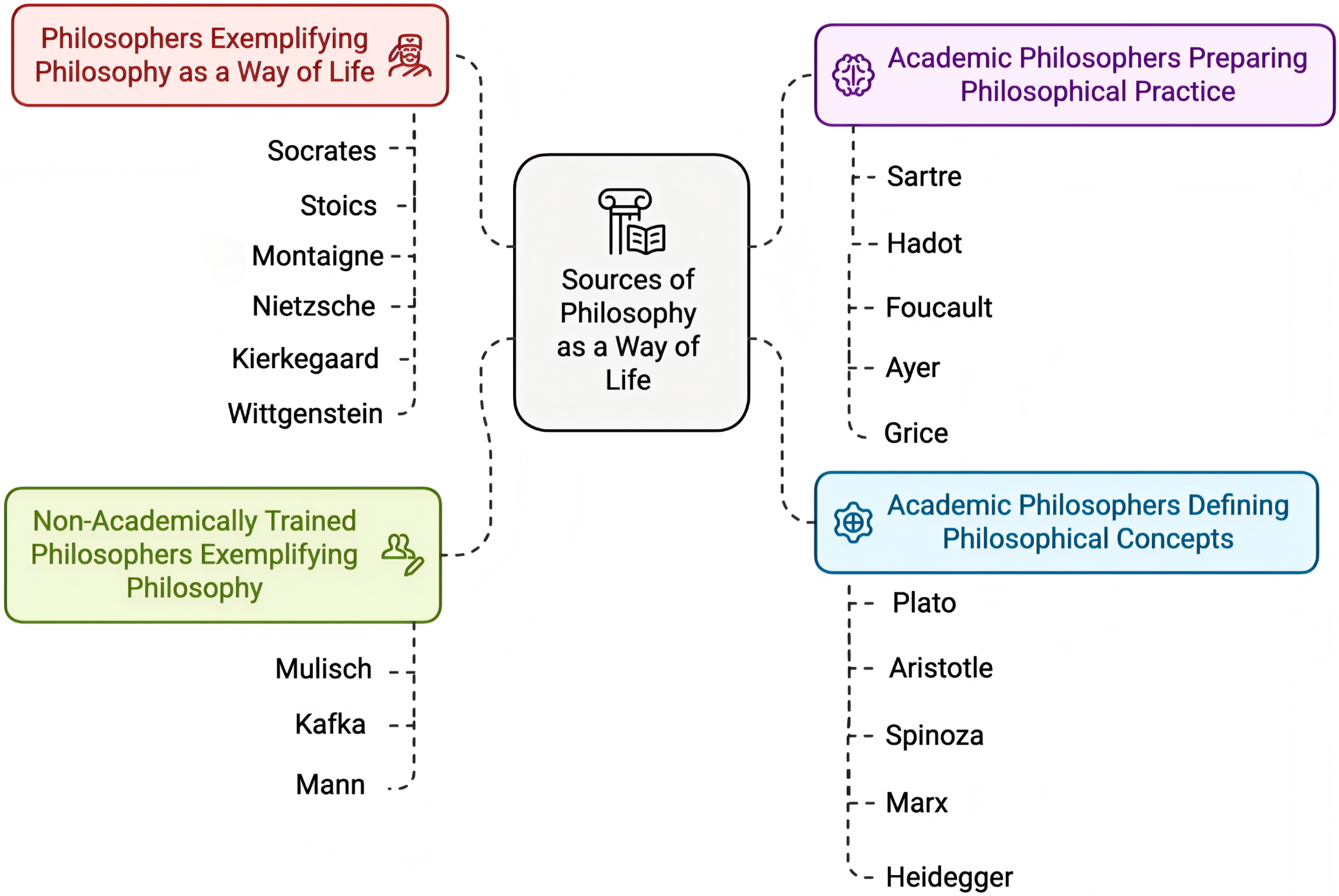
En général, les sources philosophiques définissent la pratique philosophique comme intrinsèquement philosophique, même si les philosophes cités n’étaient peut-être pas des praticiens au sens moderne du terme. Il existe essentiellement quatre types de sources (voir figure 2) :
(1) Les philosophes qui incarnent la philosophie comme mode de vie : cette catégorie comprend des philosophes tels que Socrate, les stoïciens (par exemple Sénèque, Épictète, Marc Aurèle), Michel de Montaigne, Nietzsche, Kierkegaard et Wittgenstein. Ils ont vécu leur philosophie, incarnant leurs principes philosophiques dans leur vie quotidienne.
(2) Les philosophes universitaires qui ont ouvert la voie à la pratique philosophique : des philosophes tels que Jean-Paul Sartre, Pierre Hadot et Michel Foucault entrent dans cette catégorie. Ils ont comblé le fossé entre la philosophie universitaire et la pratique philosophique ; Sartre, par exemple, a utilisé des pièces de théâtre, des romans et des essais pour diffuser les idées existentialistes. De plus, la philosophie du langage ordinaire développée par A. J. Ayer et Paul Grice a jeté les bases des consultations philosophiques avec des clients et des invités dépourvus de formation universitaire formelle.
(3) Les philosophes universitaires qui ont travaillé sur des concepts permettant de définir la pratique philosophique en tant que telle : cela inclut des philosophes tels que Platon, Aristote, Baruch de Spinoza, Karl Marx, Martin Heidegger et d’autres qui ont développé des concepts et des théories fondamentaux qui éclairent la pratique philosophique.
(4) Les philosophes sans formation universitaire qui incarnent la philosophie comme mode de vie : cela inclut des auteurs tels que Harry Mulisch, Franz Kafka, Thomas Mann et d’autres qui, à travers leurs œuvres littéraires, ont exploré des thèmes philosophiques profonds et contribué au discours philosophique.
4.2 Approches centrées sur le client : Logique, Existence et Phénoménologie
En examinant ce que font concrètement les praticiens de la philosophie, on peut définir la consultation philosophique comme un dialogue en tête-à-tête entre un philosophe et un client (invité) dans un espace privé, au cours duquel ils discutent de questions, de problèmes, d’inquiétudes ou de thèmes liés à la réflexion ou à la vie, en utilisant des moyens philosophiques et en gardant à l’esprit une approche philosophique (Harteloh, référence Harteloh2023). Cette définition s’aligne sur une définition générale de la psychothérapie comme une interaction entre un psychologue et un client visant à traiter un état mental indésirable ou un comportement perturbateur à l’aide de moyens psychologiques — une technique qui peut s’apprendre ou s’acquérir par la formation, orientée vers un objectif précis, et fondée sur une théorie de la normalité et de l’anormalité. Cependant, les différences entre la psychothérapie et les consultations philosophiques résident dans l’idée sous-jacente (pathologie contre philosophie), l’intention (traitement contre discussion), l’objet (état mental indésirable contre thème de la vie), les moyens (technique standardisée contre philosophie) et la relation avec le client (hiérarchique contre « co-penseur »). Une consultation philosophique peut être considérée comme une enquête philosophique sur le sens, dans la lignée de l’approche philosophique de Wittgenstein tardif, qui voyait la philosophie comme une forme de thérapie pour l’intellect (Wittgenstein, Référence Wittgenstein, Anscombe et Rhees1953).
Robertson (Référence Robertson 1998) considère le conseil philosophique, à l’instar de l’éthique appliquée, comme un sous-domaine de la philosophie appliquée. Dans la pratique philosophique, les praticiens et les clients traitent de questions personnelles et spécifiques à la vie. Les praticiens philosophiques, inspirés par la philosophie académique, utilisent une série de techniques philosophiques pour rendre leurs dialogues avec les clients véritablement philosophiques, en abordant les problèmes de vie privés et concrets des clients.
Lahav (Référence Lahav, Lahav et da Venza Tillmanns 1995) considère le conseil philosophique comme une forme d’interprétation de la vision du monde, proposant que différentes approches du conseil philosophique disposent de diverses méthodes pour interpréter les visions du monde. Il affirme que les diverses approches du conseil philosophique reposent sur un principe : différents aspects de la vie quotidienne peuvent être interprétés comme des expressions de nos concepts de soi et du monde. Ces concepts peuvent être expérientiels ou philosophiques, et leur somme constitue la vision du monde d’une personne.
Lydia Amir (Référence Amir 2004) assimile directement le conseil philosophique à ses méthodes, suggérant qu’il s’agit d’un ensemble d’approches qui utilisent des moyens philosophiques pour résoudre les problèmes et les dilemmes de la vie quotidienne. Schuster (Référence Schuster 1999) estime que le conseil philosophique implique une attention philosophique portée au moi du client à travers un dialogue autonome entre le conseiller et le client.
4.3 L’intégration de la sagesse orientale dans la pratique
La pratique philosophique n’est pas simplement l’application de la philosophie à un objet, un cas ou une personne indépendants ; c’est la philosophie en tant que mode de vie — vivre les concepts philosophiques. Elle représente un mode de philosophie où l’acte de philosopher définit la philosophie elle-même. L’un des principaux objectifs de la pratique philosophique est de discuter ou de résoudre les dilemmes cognitifs quotidiens, de façonner les philosophies de vie des individus et d’établir des systèmes de valeurs personnels. Les consultations philosophiques soutiennent la philosophie en tant que mode de vie, permettant aux participants non seulement de réfléchir aux philosophes ou à la philosophie, mais aussi de philosopher eux-mêmes.
Michael Grosso (Référence Grosso2012) considère le conseil philosophique comme un art conceptuel, affirmant que son but est d’aider les clients à envisager leurs problèmes sous un angle nouveau, leur permettant ainsi de les surmonter différemment. Yohsuke Tsuchiya et Mai Miyata (Référence Tsuchiya et Miyata2015) considèrent le conseil philosophique comme un outil viable dans le cadre de la Philosophie pour les enfants (P4C) pour développer les vertus intellectuelles des enfants. Au-delà de la formation aux méthodes de réflexion et de la quête de la sagesse, certains chercheurs soutiennent que le conseil philosophique est un moyen important pour l’éducation aux vertus éthiques. Barbara Jones (Référence Jones2012) considère le cabaret comique comme une forme de conseil philosophique, dans laquelle les artistes dispensent une éducation morale au public en racontant des histoires personnelles revêtant une signification universelle. James A. Tuedio (Référence Tuedio2003) souligne que le conseil philosophique ne promet pas de résultats utilitaires ultimes ; la seule responsabilité du philosophe est de s’engager dans une recherche et un questionnement continus.
4.4 Diverses méthodes et modèles de consultations philosophiques
Les praticiens de la philosophie abordent un large éventail de questions, allant des crises existentielles personnelles aux dilemmes éthiques en milieu professionnel. La polyvalence de la pratique philosophique la rend applicable à un large public, renforçant ainsi sa pertinence et son impact.
Une mission importante du conseil philosophique contemporain, depuis sa création, a été de remettre en question les présupposés théoriques, les méthodes et l’efficacité du conseil psychologique et de la psychothérapie. De nombreux chercheurs considèrent le conseil philosophique comme une alternative au conseil psychologique et à la psychothérapie, tentant de fournir une orientation de vie rationnelle de manière indépendante par le biais du conseil philosophique, sans utiliser de moyens psychothérapeutiques (Achenbach et al., 1984 ; Marinoff, 2001 ; Raabe, 2010). À l’inverse, J. Michael Russell (2001) soutient que la simple comparaison de ce que font les conseillers philosophiques et les psychothérapeutes, et des raisons pour lesquelles ils le font, ne révèle aucune frontière claire et distincte entre les deux. Amir (2004) souligne également qu’une composante décisive du conseil philosophique réside dans l’expertise et l’expérience psychologiques pertinentes du conseiller ; autrement, ce dernier risque de s’égarer dans son propre labyrinthe philosophique.
La pratique philosophique partage certaines similitudes avec la psychothérapie, particulièrement dans l’accent mis sur le développement personnel et la résolution de problèmes. Cependant, il existe des différences clés. La pratique philosophique met l’accent sur le raisonnement et le dialogue philosophiques, tandis que la psychothérapie se concentre souvent sur les théories psychologiques et les techniques thérapeutiques. Comprendre ces différences est crucial pour définir les contributions uniques de la pratique philosophique.
Les chercheurs différencient souvent la pratique philosophique de la psychothérapie en se basant sur les concepts, les fondements théoriques, les objectifs, les méthodes et les publics cibles (Dâlcu, 2022 ; Fischer, 2011 ; Sivil, 2009 ; Valencia Magallón, 2019 ; Wei, 2013 ; Yang, 2015 ; Yu, 2010). Certains soutiennent que le conseil philosophique est plus efficace que le conseil psychologique pour clarifier les systèmes de croyances confus des clients ou pour proposer de meilleures croyances (Li, 2015). Harteloh (2023) note que la pratique philosophique transcende la psychothérapie traditionnelle en se concentrant sur la résolution de problèmes philosophiques de la vie par le dialogue, plutôt que sur le simple traitement de troubles psychologiques. D’autres chercheurs considèrent le conseil philosophique et la psychothérapie comme complémentaires (Cohen, 2013a ; Ha?egan, 2019b ; Liu & Ge, 2011 ; Zhou & Liu, 2009). Cependant, le débat persiste sur la question de savoir si le conseil philosophique peut être considéré comme une forme de thérapie (Šulavíková, 2012).
Certains chercheurs estiment que, bien que le conseil philosophique ne puisse pas remplacer complètement la psychothérapie, les psychothérapeutes doivent utiliser le conseil philosophique pour offrir aux clients des moyens plus efficaces et profonds d’atténuer les troubles psychologiques. Par conséquent, ils considèrent le conseil philosophique comme un outil supplémentaire à la psychothérapie (Cohen, 2013b). Jon Mills (2001) affirme que le conseil philosophique est une forme de psychothérapie, mais qu’il nécessite une structure et une orientation pour devenir une approche fiable de résolution des problèmes psychologiques — un paradigme « philosophico-psychologique » tant dans la théorie que dans la pratique.
En explorant la relation entre les consultations philosophiques et les diverses formes de psychothérapie, il est évident que certaines approches psychothérapeutiques possèdent des fondements philosophiques profondément ancrés. Sigmund Freud a introduit des théories qui sondent l’esprit inconscient, explorant des concepts tels qu’eros (pulsions de vie) et thanatos (pulsions de mort) (Freud, 1920/1955). Les spéculations de Freud sur ces pulsions humaines fondamentales reflètent des interrogations philosophiques sur la nature humaine, l’éthique et le sens de l’existence. Certains chercheurs contemporains suggèrent que l’œuvre de Freud chevauche la frontière entre la psychologie et la philosophie, postulant qu’il pourrait être considéré comme un philosophe à part entière en raison de ses réflexions profondes sur la condition humaine (DiCenso, 2005 ; Falque, 2020 ; Wakefield, 2018).
De même, la thérapie centrée sur le client de Rogers met l’accent sur l’expérience subjective de l’individu et sa capacité innée d’auto-actualisation (Rogers, 1951). Cette approche humaniste favorise un environnement d’empathie, d’authenticité et de considération positive inconditionnelle, permettant aux clients d’explorer librement leurs pensées et sentiments intérieurs. L’accent mis sur la croissance personnelle et l’exploration de soi résonne avec l’importance accordée par le conseil philosophique au dialogue et à la compréhension de soi. L’approche de Rogers est parfois considérée comme philosophique car elle se centre sur des thèmes existentiels, tels que l’authenticité et la quête de sens, qui sont des préoccupations fondamentales de la philosophie (Cooper, 2003).
La thérapie cognitivo-comportementale (TCC), bien que déjà reconnue pour ses racines stoïciennes, reflète également des principes associés à Descartes. L’accent mis par Descartes sur la pensée rationnelle et le doute (« cogito, ergo sum ») souligne le pouvoir de la cognition dans la compréhension de la réalité (Descartes, 1641/1998). La TCC postule que les schémas de pensée dysfonctionnels contribuent à la détresse émotionnelle et aux problèmes comportementaux, et qu’en remettant en question et en modifiant ces pensées, les individus peuvent atteindre un bien-être émotionnel (Beck, 1976). L’accent cartésien sur le doute systématique et l’analyse rationnelle est parallèle aux techniques de la TCC visant à identifier et restructurer les croyances inadaptées (Hofmann et al., 2013).
En outre, la thérapie systémique, y compris la thérapie des systèmes familiaux développée par Murray Bowen (1985), introduit une perspective holistique en considérant les individus dans le contexte de leurs relations et de systèmes sociaux plus larges. Cette approche s’aligne sur les notions philosophiques d’interconnectivité et sur les dimensions sociales de l’existence humaine, telles qu’explorées par Buber dans son concept de relation « Je-Tu » (Buber, 1970). Les consultations philosophiques intègrent souvent des discussions sur le rôle de l’individu au sein de ses réseaux familiaux et sociaux, examinant comment ces relations impactent leurs défis personnels et leurs perspectives philosophiques (Goldenberg et al., 2016).
En résumé, bien que les consultations philosophiques et les diverses approches psychothérapeutiques puissent partager des objectifs communs et se chevaucher dans certaines techniques, le conseil philosophique se distingue en ancrant sa pratique explicitement dans des théories et des méthodologies philosophiques. Il privilégie le dialogue ouvert, la réflexion critique et l’exploration de questions existentielles, visant à donner aux individus les moyens de construire leurs propres significations et philosophies de vie. La psychothérapie prend ses racines dans la philosophie, mais son adoption d’un modèle médical/thérapeutique occulte souvent ces fondements philosophiques sous-jacents. Reconnaître l’interaction entre la philosophie et la psychologie enrichit les deux domaines, offrant une compréhension plus complète de la pensée et du comportement humains.
4.5 Diversité des méthodes et modèles de consultations philosophiques
Le conseil philosophique présente une diversité méthodologique significative, reflétant la variété des ressources et des approches philosophiques sur lesquelles les praticiens s’appuient dans leurs activités de conseil. Les philosophes peuvent adopter différentes méthodes qu’ils jugent efficaces comme vecteurs d’engagement avec les clients, les approches courantes incluant le dialogue socratique, l’analyse phénoménologique et le questionnement existentiel. Ces méthodologies visent à favoriser l’autoréflexion et la pensée critique, permettant aux individus d’acquérir une compréhension plus profonde de leur vie et de leurs défis.
Bien que l’on pense souvent que la pratique philosophique nécessite une approche méthodique ou structurée pour guider son processus, cette hypothèse n’est pas universellement acceptée. Raabe (2001) soutient que le domaine de la pratique philosophique n’est pas encore parvenu à un consensus sur la nécessité de méthodes spécifiques ou sur l’existence d’une méthode unique et définitive. Achenbach s’oppose à la nécessité de toute méthode spécifique. Il estime que la pratique philosophique doit être flexible et adaptable, soulignant l’importance d’un dialogue libre et ouvert qui réponde aux besoins et aux contextes uniques de chaque individu (Achenbach et al., 1984). Une adhésion rigide à une méthode particulière pourrait, selon lui, contraindre la nature dynamique et exploratoire de l’enquête philosophique.
Harteloh (2013a) soutient qu’une consultation philosophique doit être guidée par une idée philosophique centrale. Lorsque le philosophe traduit les expressions d’un client en concepts — tels que la justice, la liberté ou le bonheur — et les situe dans leur contexte historique, la consultation acquiert un caractère distinctement philosophique. Par exemple, si un client discute de l’autonomie, le consultant peut examiner la définition du concept et son rôle dans la vision du monde du client en le reliant à son héritage philosophique. Par conséquent, le consultant peut proposer des interprétations alternatives qui élargissent la perspective du client et l’aident à résoudre son dilemme (Harteloh, 2023).
À la lumière de ces perspectives divergentes, notre exploration de la pratique philosophique reconnaît à la fois les avantages potentiels des approches méthodiques et les arguments en faveur d’une pratique plus fluide et individualisée. Cette vision équilibrée permet une compréhension plus large de la manière dont la pratique philosophique peut être menée efficacement, en s’adaptant à diverses traditions philosophiques et aux préférences des praticiens. L’accent mis sur les principes plutôt que sur les méthodes prescriptives s’aligne sur les principes fondamentaux de la philosophie, encourageant l’adaptabilité et la transformation personnelle par la réflexion critique et le dialogue.
Lorsqu’il examine la question de la méthode par rapport au principe, Achenbach postule que le conseil philosophique se caractérise non par une méthode fixe, mais par la flexibilité d’appliquer diverses approches (par exemple, l’analytique, la phénoménologie, l’herméneutique) d’une manière adaptée à chaque client. Au lieu d’adhérer à une procédure uniforme, le processus est guidé par des principes philosophiques directeurs (Achenbach et al., 1984). Selon Achenbach, le conseil ne doit pas adhérer à une méthode standardisée, qui risquerait de reproduire la personne comme un produit de cette méthode. Au contraire, l’adoption de principes philosophiques permet un ajustement individuel et donne à la personne le pouvoir de se reconstruire de manière authentique en réponse à sa situation unique.
Divers chercheurs ont proposé différentes méthodes et formes de pratique philosophique. Les approches et principes représentatifs incluent :
-
Méthode au-delà de la méthode (Achenbach et al., 1984)
-
Méthode des exercices spirituels (Hadot, 1995)
-
Méthode d’interprétation de la vision du monde (Lahav, 1995)
-
Processus PEACE (Marinoff, 2001)
-
Méthode FIIT (Raabe, 2001)
-
Méthode existentielle (Russell, 2001)
-
LBT [Logic-Based Therapy] (Cohen, 2003a)
-
Méthode C.I.S.A. (Li, 2007)
-
Méthode du stoïcisme romain (Lahav, 2009)
-
Dialogue néo-socratique (Littig, 2010)
-
Méthode IDEA (Ferraiolo, 2010)
-
Méthode de l’arbre des problèmes [Issues Tree] (Raabe, 2013)
-
Analyse de la pensée (Pan, 2013)
-
Conseil de la pensée (Wang, 2014)
-
Méthode épicurienne (Fati? & Dentsoras, 2014)
-
Méthode de l’humour (Amir, 2014)
-
Méthode de la poésie (Rolfs, 2015)
-
Méthode APA (Ding, 2016)
-
Méthode réflexive (Harteloh, 2023)
La pratique philosophique englobe également diverses formes telles que les cafés philosophiques (Ding, 2019 ; Grosso, 2002 ; Harteloh, 2019 ; Katini? & Janeš, 2021), la philosophie pour enfants [P4C] (Daniel & Auriac, 2011 ; Juuso, 2007 ; Pan, 2007), et les marches philosophiques (Harteloh, 2013b). Harteloh développe le concept de la marche philosophique, la définissant comme plus qu’une activité physique, mais comme une exploration de l’esprit. En marchant, en choisissant des itinéraires spécifiques et en s’engageant dans le dialogue, les marches philosophiques encouragent l’interaction avec la nature et la société, favorisant une réflexion philosophique profonde. Par exemple, une marche philosophique a été organisée à l’Université de Nanjing en 2013 (Harteloh, 2021). L’approche de Harteloh intègre des compétences philosophiques fondamentales telles que la contemplation, le questionnement et la conceptualisation, créant une expérience unique qui relie les concepts, la sagesse philosophique et le lieu.
4.6 Critères d’admission, méthodes de formation, normes de valeurs et directives éthiques dans l’industrie de la consultation philosophique
En tant que profession relativement jeune, encore en phase de maturation et d’amélioration, le conseil philosophique fait face à des enjeux pratiques liés à son fonctionnement et à son développement. Eric Hoffman (2003) propose un plan raisonnable pour le développement futur des conseillers et des organisations philosophiques, préconisant une formation standardisée et des directives professionnelles claires. David A. Jopling (1996) met en garde le public contre les dangers potentiels pouvant survenir dans certaines situations impliquant le conseil philosophique, soulignant la nécessité d’une vigilance éthique. Mills (1999) examine les codes d’éthique professionnelle publiés par la Société canadienne de pratique philosophique, l’APPA et l’American Society for Philosophy, Counseling, and Psychotherapy, en soulignant les ambiguïtés de ces codes et en plaidant pour des normes éthiques plus claires. Schuster (1999) offre des conseils pratiques aux conseillers philosophiques américains préoccupés par la responsabilité civile, insistant sur l’importance d’une pratique éthique et de la responsabilité professionnelle.
Des études récentes ont approfondi l’exploration de la professionnalisation du conseil philosophique. Julia Clare et Richard Sivil (2014) discutent des normes de formation et de certification des praticiens philosophes, soulignant la nécessité d’une éducation complète incluant à la fois des connaissances philosophiques et des compétences en conseil. Tim LeBon (2001) examine les responsabilités éthiques des conseillers philosophiques, mettant en lumière l’importance d’établir des directives éthiques claires pour protéger tant les clients que les praticiens. Ces discussions soulignent les efforts continus au sein de la communauté du conseil philosophique pour formaliser les programmes de formation, standardiser les qualifications et renforcer l’intégrité professionnelle du domaine.
Plus précisément, les questions saillantes dans l’éducation et la formation à la consultation philosophique incluent :
(1) Les compétences philosophiques comme partie intégrante du programme
Les compétences philosophiques sont au cœur des programmes de formation des praticiens philosophes. Harteloh (2010) met en avant des compétences critiques pour le conseil philosophique, notamment l’analyse logique, le raisonnement éthique, la compréhension herméneutique et le dialogue dialectique, tout en classant les compétences pratiques comme le questionnement, l’interprétation et la compréhension. Les praticiens doivent exceller dans la construction et la déconstruction d’arguments complexes, l’identification des présupposés sous-jacents et l’animation de discussions significatives. Ils doivent également développer des métaphores pour articuler et clarifier le sens lors des interactions avec le client. De plus, la connaissance des traditions philosophiques tant occidentales que non occidentales dote les praticiens d’une boîte à outils diversifiée pour répondre aux préoccupations des clients sous de multiples angles et situer leur discours au sein d’une tradition intellectuelle séculaire.
(2) Littérature utilisée dans le programme
Les programmes de formation intègrent un large éventail de textes philosophiques pour établir une base théorique solide. Les lectures fondamentales incluent des œuvres classiques comme les dialogues de Platon, L’Éthique à Nicomaque d’Aristote et la Critique de la raison pratique de Kant, aux côtés de textes modernes tels que les Recherches philosophiques de Wittgenstein et Être et Temps de Heidegger. Des ouvrages pratiques, notamment Philosophical Practice d’Achenbach et al. (1984) et Platon, pas Prozac ! de Marinoff (1999), font le lien entre la théorie et l’application. Ce curriculum diversifié permet aux praticiens de s’appuyer sur des idées pertinentes lors des consultations. En outre, il permet aux étudiants d’identifier des points de référence philosophiques qui étayent leur pratique comme étant intrinsèquement philosophique.
(3) L’exigence d’un Master en philosophie pour l’admission
Étant donné que la pratique philosophique s’appuie sur la capacité humaine inhérente à philosopher, l’exigence d’un master en philosophie pour l’admission reste contestée. La formation académique ne produit pas nécessairement les compétences communicationnelles essentielles à une pratique philosophique efficace ; un diplômé peut exceller en philosophie théorique tout en manquant d’aptitude pour un dialogue pratique et engagé. Inversement, une personne n’ayant pas reçu de formation académique peut développer de solides compétences en matière de questionnement, de spéculation et d’interprétation des idées lors de communications interpersonnelles. Dans le langage courant, une telle personne est simplement considérée comme « un philosophe ». Des organisations comme l’APPA soutiennent qu’une formation académique avancée garantit une compréhension rigoureuse des méthodes philosophiques (APPA, s.d.). Les critiques soutiennent que des exigences strictes peuvent exclure des praticiens capables et négliger des perspectives interdisciplinaires. Le débat se concentre sur l’équilibre entre la nécessité d’une expertise philosophique rigoureuse et l’inclusivité ainsi que la reconnaissance de parcours éducatifs divers (Clare & Sivil, 2014).
(4) Critères d’admission pour les personnes sans Master en philosophie
Pour les candidats sans master, les critères alternatifs peuvent inclure des portfolios, des études antérieures et une expérience professionnelle pertinente. Un entretien d’admission mené par des praticiens philosophes expérimentés peut servir à évaluer et à reconnaître l’aptitude d’un individu en tant que philosophe, sur la base de son attitude et de son mode de raisonnement. Certains programmes proposent des cours de base ou des évaluations pour juger des compétences philosophiques. Ces voies visent à maintenir les standards tout en élargissant l’accès à la profession (LeBon, 2001).
(5) Développement de l’étudiant (Bildung) et durée de la formation
Le développement de l’étudiant, ou Bildung, fait référence au processus éducatif holistique axé sur la croissance personnelle et intellectuelle. L’étudiant doit développer un style de pratique personnel en intégrant les éléments centraux du programme : cultiver la sagesse, étudier les biographies de philosophes comme modèles, interpréter des textes originaux et s’engager dans des exercices ciblés. Les programmes s’étendent généralement sur 1 à 2 ans, combinant l’enseignement théorique et l’étude d’exemples avec une pratique supervisée, des ateliers et du mentorat. Les exigences varient ; l’accent est mis sur les connaissances, les compétences interpersonnelles, la conscience de soi et la sensibilité éthique (Mills, 1999).
(6) Critères d’obtention du diplôme (Thèse, consultations, supervision)
L’obtention du diplôme requiert des accomplissements tant académiques que pratiques. Les étudiants peuvent rédiger une thèse ou un projet de recherche démontrant leur compréhension des principes du conseil philosophique. Cependant, l’exigence la plus cruciale est qu’ils démontrent leurs compétences à travers une série de consultations enregistrées. Les composantes pratiques incluent souvent au moins un an de consultations supervisées pour développer une expérience concrète. La supervision par des praticiens expérimentés garantit l’affinement des compétences et le respect de l’éthique (Hoffman, 2003). Par exemple, selon les directives de la Société coréenne de conseil philosophique, pour se qualifier en tant que conseiller professionnel, les candidats doivent détenir un master ou un diplôme supérieur, valider plus de 240 heures de cours liés à la philosophie, participer à plus de 160 heures d’ateliers, s’engager dans au moins 50 heures d’activités sociétales et effectuer plus de 70 heures d’activités sous supervision. De plus, ils sont tenus de présenter au moins un cas de conseil et de publier au moins trois articles de recherche indépendants.
En résumé, la communauté académique a développé des recherches relativement matures et complètes sur les théories et les applications du conseil philosophique, réalisant des percées et des innovations significatives dans le développement de divers modèles et méthodes de conseil. En particulier, les chercheurs chinois ont accompli des progrès substantiels dans les introductions théoriques et dans l’exploration des pensées et de la sagesse pratiques de la philosophie chinoise traditionnelle (Ding et al., 2024c). La croissance continue et la professionnalisation du conseil philosophique dépendent de la prise en compte de ces considérations éducatives et éthiques, garantissant que les praticiens soient bien équipés pour répondre aux besoins évolutifs des clients. La pratique philosophique offre une voie de carrière alternative au-delà des rôles académiques traditionnels. Au lieu de briguer des postes d’enseignants ou de chercheurs après des études académiques en philosophie, les étudiants peuvent être formés pour devenir des philosophes praticiens. Cette approche leur permet d’exercer en cabinet privé hors du cadre universitaire, au service d’une clientèle diversifiée pouvant inclure des individus, des écoles ou des entreprises. Cette forme de pratique met l’accent sur l’application pratique des intuitions philosophiques, favorisant un engagement direct avec les dilemmes du monde réel tout en s’appuyant sur les riches traditions de l’enquête philosophique.
5. Professionnalisation : Certification, normes et éthique
Alors que la pratique philosophique continue de prendre de l’ampleur, elle se trouve à une jonction charnière entre la philosophie académique traditionnelle et son application pratique dans la société. L’évolution de la pratique philosophique influence non seulement la manière dont la philosophie est perçue, mais ouvre également de nouvelles voies pour le développement professionnel et l’engagement public. Cette section explore la professionnalisation du conseil philosophique, son état actuel, ses défis et ses orientations futures potentielles.
5.1 L’essor du conseil philosophique en tant que profession mondiale
En tant que nouvelle dynamique de la recherche philosophique, la pratique philosophique a donné naissance à une profession distincte : le conseil philosophique. À certains égards, la professionnalisation du conseil philosophique a précédé la recherche théorique ou, à tout le moins, a progressé simultanément avec elle. L’établissement d’une institution de pratique philosophique spécialisée par le philosophe allemand Gerd B. Achenbach en 1981 a marqué le début formel du conseil philosophique contemporain au sein d’un cabinet privé hors du milieu universitaire. Il est important de distinguer la pratique philosophique du conseil ; bien que le mouvement de la pratique philosophique soit antérieur à cette période, le conseil philosophique explicite a véritablement commencé avec Achenbach, s’appuyant sur des intégrations implicites antérieures de la philosophie dans le conseil psychologique.
Comme nous l’avons vu précédemment, le conseil philosophique, en tant que forme de consultation, engage les clients dans un dialogue philosophique pour les aider à réfléchir sur des événements de vie significatifs, à résoudre le deuil et la douleur résultant de transitions majeures, et à trouver du sens et un but. Ce sont des questions cruciales auxquelles la plupart des gens sont confrontés à une étape de leur vie. Plutôt que de simplement appliquer les idées de grands philosophes — un concept plus adapté au conseil psychologique — le conseil philosophique implique de « philosopher avec » les clients, favorisant une exploration collaborative des idées et des croyances.
À l’heure actuelle, de nombreux conseillers philosophiques exercent à temps partiel ; leurs rôles principaux consistent à enseigner et à mener des recherches académiques dans des universités ou des collèges. Cependant, certains travaillent à plein temps dans ce domaine en tant qu’indépendants. Le conseil philosophique n’est pas encore une catégorie d’emploi traditionnelle et n’a pas été intégré dans les marchés du travail régulés par les gouvernements ou dans les systèmes de santé. Il reste largement une entreprise personnelle menée par des philosophes employant leur intellect et leurs connaissances, caractérisée par une indépendance distinctive. Certains praticiens philosophes créent leurs propres instituts, leurs sites web personnels et s’affilient à des associations de pratique philosophique pour attirer des clients et générer des affaires. Leurs méthodes de communication ne se limitent pas aux conversations en face à face, mais tirent également parti des commodités de l’ère numérique, développant des méthodes de consultation utilisant des outils de communication modernes tels que le téléphone, le courrier électronique et les plateformes de vidéoconférence comme Zoom ou Tencent Meeting.
5.2 Faire progresser les normes professionnelles et les qualifications dans le conseil philosophique
Pour les conseillers philosophiques, la philosophie est devenue un outil qui non seulement enrichit la vie, mais offre également un parcours de carrière viable, leur permettant de gagner leur vie et de s’établir professionnellement. Dans le climat économique mondial actuel, c’est sans aucun doute une nouvelle encourageante pour les diplômés en philosophie qui font face à des défis importants sur le marché du travail. De nombreux départements de philosophie ont inclus le « conseil philosophique » comme une orientation de carrière potentielle pour les diplômés en philosophie dans leurs brochures d’inscription et fournissent ou recommandent des cours de formation professionnelle pertinents aux étudiants.
Pour obtenir des qualifications professionnelles et devenir un praticien philosophe certifié, certaines conditions doivent être remplies. En prenant l’APPA comme exemple, la certification peut être obtenue par invitation, par candidature ou par formation. Des praticiens distingués peuvent être invités à devenir membres certifiés ou à rejoindre le corps professoral de l’APPA. Les praticiens expérimentés répondant aux exigences de l’APPA peuvent demander une certification. L’APPA propose également des programmes de niveau I (introductif) et de niveau II (avancé) en conseil, en facilitation et en consultation. Les programmes sont menés à l’échelle mondiale sous la supervision du corps professoral de l’APPA, couvrant les compétences fondamentales, les analyses de cas avancées et les applications pratiques. L’APPA met l’accent sur les vertus professionnelles que sont l’expertise, l’excellence et l’intégrité, avec des normes de certification strictes pour garantir une pratique de haute qualité.
Actuellement, parallèlement à l’augmentation rapide du nombre de praticiens philosophes, la base de clients de la pratique philosophique ne cesse de s’étendre. De plus en plus d’individus, de groupes et d’organisations recherchent consciemment et proactivement l’aide de philosophes. Une analyse comparative des données de trafic via la plateforme Similarweb montre qu’en mai 2025, le site officiel de l’APPA a enregistré 3 512 visites — soit une baisse de 51,39 % par rapport à avril 2025 — avec une durée moyenne de visite sur site de 38 secondes. En revanche, le site de la NPCA a enregistré 2 267 visites en mai 2025 — soit une augmentation de 49,36 % par rapport à avril 2025 — avec une durée moyenne de visite sur site de 2 minutes et 25 secondes. De plus, l’influence de la pratique philosophique sur la philosophie académique dominante devient de plus en plus significative. L’interaction entre la pratique philosophique et la philosophie académique, traditionnellement limitée à l’enseignement et à la recherche théorique, a donné des résultats fructueux.
La pratique philosophique révèle de nouvelles approches dans la recherche philosophique, nécessitant l’introduction de nouvelles ressources et méthodes distinctes de l’exploration philosophique traditionnelle. En d’autres termes, elle emploie les théories et méthodes philosophiques existantes de manière innovante ou sous des angles différents dans la vie quotidienne. Le domaine de la pratique philosophique est sans aucun doute passionnant ; son émergence lie étroitement la philosophie aux questions qui importent aux profanes. Simultanément, la pratique philosophique s’efforce de devenir une véritable discipline au sein de l’établissement philosophique académique. En tant qu’application de la philosophie, elle a soulevé de nouvelles questions philosophiques dans de nombreux aspects de la vie philosophique (Li et al., 2024). Par conséquent, la pratique philosophique est à la fois une profession — un nouveau membre de la philosophie appliquée — et un sujet philosophique — un nouveau paradigme dans la recherche philosophique. Le passage d’un paradigme théorique à un paradigme pratique transforme par essence la philosophie, d’une poursuite académique d’élite et exclusive, en une culture séculaire à laquelle tout le monde peut participer.
6. Conclusion
La pratique philosophique représente un changement transformateur dans la manière dont la philosophie est perçue et appliquée, passant d’exercices académiques abstraits à une discipline pratique répondant directement aux préoccupations quotidiennes. En jetant un pont entre la théorie et la pratique, le conseil philosophique offre aux individus, aux groupes et aux organisations des outils pour naviguer à travers les défis existentiels, clarifier leurs croyances et atteindre une croissance personnelle. L’émergence de la pratique philosophique en tant que nouveau paradigme revitalise la pertinence de la philosophie et contribue au bien-être de la société.
La professionnalisation du conseil philosophique est essentielle pour établir sa légitimité et son efficacité. Le développement de formations standardisées et de directives éthiques, l’examen de l’efficacité des méthodologies de conseil philosophique et l’intégration de la pratique philosophique dans les systèmes de santé peuvent renforcer son accessibilité et son impact. À mesure que le domaine évolue, il est essentiel de relever les défis liés à la reconnaissance professionnelle, aux exigences éducatives et à l’engagement du public.
Des études comparatives entre le conseil philosophique et la psychothérapie traditionnelle peuvent éclairer les points forts et les domaines à améliorer, en identifiant comment la pratique philosophique peut compléter et enrichir les approches thérapeutiques existantes. La recherche transculturelle est indispensable pour adapter la pratique philosophique à différents contextes sociétaux, en reconnaissant les variations des valeurs culturelles, des traditions philosophiques et des styles de communication. En outre, l’exploration des plateformes numériques pour le conseil philosophique mérite une attention particulière, notamment pour élargir l’accès et répondre aux besoins évolutifs d’un monde technologiquement interconnecté.
La collaboration interdisciplinaire entre philosophes, psychologues et autres professionnels de la santé mentale peut enrichir tant les aspects théoriques que pratiques de la pratique philosophique. En comblant les fossés entre les disciplines, les praticiens peuvent développer des approches holistiques pour aborder les expériences humaines complexes. De plus, l’intégration de la pratique philosophique dans les systèmes éducatifs (par exemple, la philosophie pour enfants – P4C) pourrait favoriser la pensée critique et le raisonnement éthique dès le plus jeune âge, promouvant ainsi une société plus réflexive.
En conclusion, la pratique philosophique détient un potentiel significatif pour enrichir les vies et transformer les sociétés. En embrassant la philosophie comme mode de vie, praticiens et clients s’engagent dans des dialogues porteurs de sens, favorisant une compréhension plus profonde de la condition humaine. Le développement et l’intégration continus de la pratique philosophique contribueront à un monde plus compatissant et éclairé.
Remerciements
Nous tenons à exprimer notre sincère gratitude à Nancy Salay, rédactrice anglophone de Dialogue, pour son aimable soutien et ses conseils précieux. Nous sommes particulièrement reconnaissants envers Jill Flohil, l’assistante éditoriale, dont la révision méticuleuse et approfondie a considérablement amélioré la qualité de cet article. Ce travail a été soutenu par le projet de sciences humaines et sociales du MOE (Ministère de l’Éducation de Chine, subvention n° 19YJC720006) et la Fondation nationale des sciences sociales de Chine (subvention n° 20FZXB047).
Conflits d’intérêts
Les auteurs déclarent n’en avoir aucun.
Références
Achenbach, G. B. (2010). Zur einführung der philosophischen praxis: Vorträge, aufsätze, gespräche und essays, mit denen sich die philosophische praxis in den jahren 1981 bis 2009 vorstellte. Schriftenreihe zur philosophischen praxis band V. Verlag für Philosophie Jürgen Dinter.
Achenbach, G. B, Fischer, M., Macho, T. H., Marquard, O., & Martens, E. (1984). Philosophische praxis. Schriftenreihe zur philosophischen praxis, band I. Verlag für Philosophie Jürgen Dinter.
Adair, J. G. (1984). The Hawthorne effect: A reconsideration of the methodological artifact. Journal of Applied Psychology, 69(2), 334–345. https://doi.org/10.1037/0021-9010.69.2.334
American Philosophical Practitioners Association (APPA). (n.d.). Memberships. https://appa.edu/memberships/
Ames, R. T., & Rosemont, H. Jr (1998). The Analects of Confucius: A philosophical translation. Ballantine Books.
Amir, L. B. (2004). Three questionable assumptions of philosophical counseling. International Journal of Philosophical Practice, 2(1), 58–81. https://doi.org/10.5840/ijpp2004214
Amir, L. B. (2014). Humor and the good life in modern philosophy: Shaftesbury, Hamann, Kierkegaard. State University of New York Press.
Aristotle. (2011). Nicomachean ethics (R. C. Bartlett & S. D. Collins, Trans.). University of Chicago Press.
Baggini, J., & Macaro, A. (2012). The shrink and the sage: A guide to living. Icon Books Ltd.
Beck, A. T. (1976). Cognitive therapy and the emotional disorders. International Universities Press.
Berry, J. W. (2005). Acculturation: Living successfully in two cultures. International Journal of Intercultural Relations, 29(6), 697–712. https://doi.org/10.1016/j.ijintrel.2005.07.013
Bowen, M. (1985). Family therapy in clinical practice. Jason Aronson.
Buber, M. (1970). I and thou (W. Kaufmann, Trans.). Charles Scribner’s Sons.
Casewell, D. (2022). Philosophy of religion as a way of life: Askesis and Ethics. The Heythrop Journal, 63(5), 886–898. https://doi.org/10.1111/heyj.14128
Chen, B., Zheng, W., Zhao, L., & Ding, X. (2025). Leveraging large language models to assist philosophical counseling: Prospective techniques, value, and challenges. Humanities and Social Sciences Communications, 12(1), 1–15. https://doi.org/10.1057/s41599-025-04657-7
Chen, H. (2014). Revival of the Socratic method: A new paradigm of philosophical practice. Journal of Anhui University (Philosophy and Social Sciences Edition), 38(3), 22–26.
Chen, H., & Ni, C. (2016). Confucian thoughts of philosophical counseling. Journal of Henan University of Science & Technology (Social Science Edition), 34(2), 47–53.
Clare, J., & Sivil, R. (2014). Philosophical counselling, professionalization, and professionalism: A South African perspective. International Journal of Applied Philosophy, 28(2), 311–324. https://doi.org/10.5840/ijap2014121735
Cohen, E. D. (2003a). Philosophical principles of logic-based therapy. Practical Philosophy, 6(1): 27–35.
Cohen, E. D. (2003b). What would Aristotle do? Self-control through the power of reason. Prometheus Books.
Cohen, E. D. (2013a). Logic-based therapy: The new philosophical psychotherapy for the 21st century (X. Ding, Trans.). Journal of Nanjing University (Philosophy, Humanities and Social Sciences), 50(4), 53–59.
Cohen, E. D. (2013b). Theory and practice of logic-based therapy: Integrating critical thinking and philosophy into psychotherapy. Cambridge Scholars Publishing. https://www.cambridgescholars.com/product/978-1-4438-5053-7
Cooper, M. (2003). Existential therapies. Sage Publications.
da Venza Tillmanns, M. (1998). Philosophical counseling and teaching: “Holding the tension” in a dualistic world (Martin Buber) [Doctoral dissertation, University of Illinois at Urbana-Champaign, United States]. https://philpapers.org/rec/TILPCA
Dâlcu, A. (2022). The relationship between philosophical and psychological counselling: Where do we stand? Interdisciplinary Research in Counseling, Ethics and Philosophy, 2(6), 27–52. https://doi.org/10.59209/ircep.v2i6.41
Daniel, M. F., & Auriac, E. (2011). Philosophy, critical thinking and philosophy for children. Educational Philosophy and Theory, 43(5), 415–435. https://doi.org/10.1111/j.1469-5812.2008.00483.x
Descartes, R. (1998). Meditations on first philosophy (J. Cottingham, Trans.). Cambridge University Press. (Original work published 1641).
Devarakonda, S. (2023). Syad-narrative as a philosophical practice method to minimize cognitive biases. HASER: Revista Internacional de Filosofía Aplicada, 14, 159–179. https://doi.org/10.12795/HASER/2023.i14.08
DiCenso, J. (2005). The other Freud: Religion, culture and psychoanalysis. Routledge. 10.4324/9780203983423
Ding, X. (2016). Dialogue, analysis and therapy: The conception and construction of “analytic philosophical practice” [Doctoral dissertation, Nanjing University, China].
Ding, X. (2019). The aroma of philosophy: Philosophical cafe in theory and practice. Philosophical Practice and Counseling, 9, 53–91.
Ding, X., Fu, S., Jiao, C., & Yu, F. (2024a). Chinese philosophical practice toward self-cultivation: Integrating Confucian wisdom into philosophical counseling. Religions, 15(1), 1–18. https://doi.org/10.3390/rel15010069
Ding, X., Harteloh, P., Pan, T., & Yu, F. (2024b). The practical turn in philosophy: A revival of the ancient art of living through modern philosophical practice. Metaphilosophy, 55(4–5), 517–534. https://doi.org/10.1111/meta.12702
Ding, X., Xie, C., & Yu, F. (2024c). Philosophical practice and its development in China: Opportunities and challenges. Humanities and Social Sciences Communications, 11(1), 1–8. https://doi.org/10.1057/s41599-024-02985-8
Ding, X., Yu, F., & Han, Y. (2022). Critical thinking as the ultimate goal of philosophical practice. Science Economy Society, 40(2), 67–77.
Ellis, A., & Harper, R. A. (1997). A guide to rational living. Wilshire Books.
Ellis, A., & MacLaren, C. (2005). Rational emotive behavior therapy: A therapist’s guide (2nd ed.). Impact Publishers.
Falque, E. (2020). Nothing to it: Reading Freud as a philosopher (R. Vallier & W. L. Connelly, Trans.). Leuven University Press.
Fati?, A. (2014). Epicurean ethics in the pragmatist philosophical counsel. Essays in the Philosophy of Humanism, 22(1), 63–77. https://doi.org/10.1558/eph.v22i1.63
Fati?, A., & Dentsoras, D. (2014). Pleasure in Epicurean and Christian Orthodox conceptions of happiness. South African Journal of Philosophy, 33(4), 523–536. https://doi.org/10.1080/02580136.2014.967594
Ferraiolo, W. (2010). The IDEA method: Stoic counsel. Philosophical Practice, 5(2), 627–633. https://philpapers.org/rec/FERTIM
Fischer, E. (2011). How to practise philosophy as therapy: Philosophical therapy and therapeutic philosophy. Metaphilosophy, 42(1–2), 49–82. https://doi.org/10.1111/j.1467-9973.2010.01680.x
Freud, S. (1955). Beyond the pleasure principle. In Strachey, J. (Ed. & Trans.), The standard edition of the complete psychological works of Sigmund Freud (Volume 18, pp. 7–64). Hogarth Press. (Original work published 1920.)
Gatchel, R. J., Peng, Y. B., Peters, M. L., Fuchs, P. N., & Turk, D. C. (2007). The biopsychosocial approach to chronic pain: Scientific advances and future directions. Psychological Bulletin, 133(4), 581–624. https://doi.org/10.1037/0033-2909.133.4.581
Gill, M. L. (2012). Philosophos: Plato’s missing dialogue. Oxford University Press. 10.1093/acprof:oso/9780199606184.001.0001
Goldenberg, H., Stanton, M., & Goldenberg, I. (2016). Family therapy: An overview (9th ed.). Cengage Learning.
Grimes, P., & Uliana, R. L. (1998). Philosophical midwifery: A new paradigm for understanding human problems with its validation. Hyparxis Press.
Grosso, M. (2002). Philosophical café for spiritual health: How to start one. International Journal of Philosophical Practice, 1(3), 89–91. https://doi.org/10.5840/ijpp20021311
Grosso, M. (2012). Philosophical counseling as conceptual art. Philosophical Practice, 7(2), 952–960.
Guo, S. (2023). Marginality and individuality: The theoretical foundation of Taoist psychological counseling. Journal of Dali University, 8(1), 122–128.
Hadot, P. (1995). Philosophy as a way of life: Spiritual exercises from Socrates to Foucault (M. Chase, Trans.). Blackwell.
Harteloh, P. (2010). On the competence of philosophical counsellors. Practical Philosophy, 10(1), 36–47.
Harteloh, P. (2013a). Philosophical practice: A new paradigm in Western philosophy [In Chinese] (Z.-Y. Yang, Trans.). Journal of Anhui University (Philosophy and Social Sciences Edition), 37(5), 30–35.
Harteloh, P. (2013b). Philosophical walks. Philosophical Practice, 8(3), 1297–302.
Harteloh, P. (2013c). The diagnosis in philosophical practice. Journal of Humanities Therapy, 4, 59–73.
Harteloh, P. (2019). The philosophical cafe in the Netherlands: A place for profound speculations. Philosophical Practice and Counseling, 9, 1–25.
Harteloh, P. (2021). The nine steps of a philosophical walk. Journal of Human Cognition, 5(2), 4–16. https://doi.org/10.47297/wspjhcWSP2515-469901.20210502
Harteloh, P. (2023). On the content and form of a philosophical consultation. Journal of Humanities Therapy, 14(2), 115–130. https://doi.org/10.33252/jht.2023.12.14.2.115
Harteloh, P. (2024). Hildegard of Bingen: Philosophical life and spirituality. Religions, 15(4), 1–10. https://doi.org/10.3390/rel15040506
Ha?egan, V. P. (2019a). Philosophical practice and ethics applied in organizations. Analele Universit??ii din Bucure?ti–Seria Filosofie, 68(1), 53–65.
Ha?egan, V. P. (2019b). Therapy or counseling? Current directions of the philosophical practice. Revue Roumaine de Philosophie, 63(2), 365–382.
Heckmann, G. (1981). Das Sokratische gespräch: Erfahrungen in philosophischer und mathematischer gesprächsführung. Vittorio Klostermann.
Heisenberg, W. (1927). Über den anschaulichen Inhalt der quantentheoretischen Kinematik und Mechanik. Zeitschrift für Physik, 43(3), 172–198. 10.1007/BF01397280
Hoffman, E. (2003). The future of “philosophical counseling”: A modest vision. International Journal of Philosophical Practice, 1(4), 1–13. https://doi.org/10.5840/ijpp2003141
Hofmann, S. G., Asmundson, G. J., & Beck, A. T. (2013). The science of cognitive therapy. Behavior Therapy, 44(2), 199–212. https://doi.org/10.1016/j.beth.2009.01.007
Hofstede, G. (2001). Culture’s consequences: Comparing values, behaviors, institutions and organizations across nations (2nd ed.). Sage Publications.
Holger, G. (2017). Plato and Gadamer. On the concept of the philosophical dialogue. ??????? ?????-?????????????? ????????????. ????????? ? ??????????????, 33(3), 282–288. https://doi.org/10.21638/11701/spbu17.2017.303
Hsu, H. L. (2011). The healing effects of Buddhist philosophical counseling on life. Universitas-Monthly Review of Philosophy and Culture, 38(3), 173–187. https://doi.org/10.7065/MRPC.201103.0173
Huang, Y. (2011). On the function of philosophical counseling [Master’s thesis, Central South University, China].
Huang, Y. (2014). On application of philosophical counseling in ideological and political education. Forum on Contemporary Education, (5), 39–46.
Jones, B. (2012). The art of Cabaret as philosophical practice. Philosophical Practice, 7(2), 961–971.
Jopling, D. A. (1996). Philosophical counselling, truth and self-interpretation. Journal of Applied Philosophy, 13(3), 297–310. https://doi.org/10.1111/j.1468-5930.1996.tb00173.x
Juuso, H. (2007). Child, philosophy and education: Discussing the intellectual sources of philosophy for children. University of Oulu.
Katini?, M., & Janeš, L. (2021). Philosophical café: A philosophical dialogue and/or therapy? Interdisciplinary Research in Counseling, Ethics and Philosophy, 1(1), 51–62. https://doi.org/10.59209/ircep.v1i1.16
Knapp, S., & Tjeltveit, A. C. (2005). A review and critical analysis of philosophical counseling. Professional Psychology: Research and Practice, 36(5), 558–565. https://doi.org/10.1037/0735-7028.36.5.558
Kuhn, T. S. (1962). The structure of scientific revolutions. University of Chicago Press.
Lahav, R. (1995). A conceptual framework for philosophical counseling: Worldview interpretation. In Lahav, R. & da Venza Tillmanns, M. (Eds.), Essays on philosophical counseling (pp. 3–24). University Press of America.
Lahav, R. (1996). Philosophical counseling and Taoism: Wisdom and lived philosophical understanding. Journal of Chinese philosophy, 23(3): 259–276. https://doi.org/10.1111/j.1540-6253.1996.tb00630.x
Lahav, R. (2009). Self-talk in Marcus Aurelius’ Meditations: A lesson for philosophical practice. Philosophical Practice, 4(3), 486–491. https://philpapers.org/rec/LAHSIM
Lahav, R., & da Venza Tillmanns, M. (Eds.). (1995). Essays on philosophical counseling. University Press of America. https://appa.edu/books/essays-on-philosophical-counseling/
LeBon, T. (2001). Wise therapy: Philosophy for counsellors. Continuum. 10.4135/9781446217108
Li, B. (2007). The practice and application of the C.I.S.A theory. Universitas-Monthly Review of Philosophy and Culture, 34(1), 3–17. https://doi.org/10.7065/MRPC.200701.0003
Li, B. (2010). The three fundamental principles of philosophical counseling. Universitas-Monthly Review of Philosophy and Culture, 37 (1), 3–19. https://doi.org/10.7065/MRPC.201001.0003
Li, H., Ding, X., & Li, M. (2024). A cross-cultural comparison of Chinese and Western philosophical practice: Exploring new paths for philosophical healing and social harmony. Humanities and Social Sciences Communications, 11(1), 1–21. https://doi.org/10.1057/s41599-024-04290-w
Li, L. (2015). Improving the state of mind: The common goal of philosophical counseling and psychological counseling. Ningxia Social Sciences, (5), 11–15.
Littig, B. (2010). Neo-Socratic dialogue in practice: The xenotransplantation and genetic counseling cases. Philosophical Practice, 5(3), 685–697.
Liu, J., & Ge, R. (2011). Progress and prospect of philosophical counseling. Psychological Research, 4(4), 8–13. 10.30564/jpr.v4i1.4287
Louw, D. J. (2011). Philosophical counselling: Towards a “new approach” in pastoral care and counselling? HTS Teologiese Studies/Theological Studies, 67(2), 1–7.
Lu, C. C. (2004). Philosophical counseling of the Analects. Universitas-Monthly Review of Philosophy and Culture, 31(1), 51–66. https://doi.org/10.7065/MRPC.200401.0051
Lumley, M. A., Schubiner, H., Lockhart, N. A., Kidwell, K. M., Harte, S. E., Clauw, D. J., & Williams, D. A. (2017). Emotional awareness and expression therapy, cognitive behavioral therapy, and education for fibromyalgia: A cluster-randomized controlled trial. Pain, 158(12), 2354–2363. https://doi.org/10.1097/j.pain.0000000000001036
Lv, X. (2007). Enlightenment of the ideas of the Taoist school for adjustment and cure of one’s anxiety tendency and depressed psychology. Journal of Shanghai Normal University (Philosophy & Social Sciences Edition), (1), 93–98.
Marinoff, L. (1999). Plato, Not Prozac!: Applying eternal wisdom to everyday problems. HarperCollins.
Marinoff, L. (2001). Philosophical practice. Academic Press.
Marinoff, L. (2004). The therapy for the sane: How philosophy can change your life. Bloomsbury USA.
Maslow, A. H. (1981). Motivation and personality: Unlocking your inner drive and understanding human behavior. Prabhat Prakashan.
Merton, R. K. (1973). The sociology of science: Theoretical and empirical investigations. University of Chicago Press.
Mesaro?, C. M. (2020). Marcus Aurelius and the community of philosophical life. Synthesis Philosophica, 35(2), 367–377. https://doi.org/10.21464/sp35206
Mills, J. (1999). Ethical considerations and training recommendations for philosophical counseling. International Journal of Applied Philosophy, 13(2), 149–164. https://doi.org/10.5840/ijap199913219
Mills, J. (2001). Philosophical counseling as psychotherapy: An eclectic approach. International Journal of Philosophical Practice, 1(1), 25–47. https://doi.org/10.5840/ijpp2001112
Mochizuki, T., & Harteloh, P. (2019). Reading the correspondence between Descartes and Princess Elisabeth from the viewpoint of philosophical counselling: Introduction and research questions. Journal of Humanities Therapy, 10(1), 155–172. https://doi.org/10.33252/jht.2019.06.10.1.155
Nelson, L. (1949). Socratic method and critical philosophy: Selected essays. Yale University Press.
Neubauer, P. (2000). Faith and character: Life counseling in “philosophical practice” [Doctoral dissertation, Humboldt University of Berlin, Germany].
Nevis, E. C. (1983). Using an American perspective in understanding another culture: Toward a hierarchy of needs for the People’s Republic of China. Journal of Applied Behavioral Science, 19(3), 249–264. https://doi.org/10.1177/002188638301900304
Ollinheimo, A., & Hakkarainen, K. (2023). Critical thinking as cooperation and its relation to mental health and social welfare. New Ideas in Psychology, 68, 1–14. https://doi.org/10.1016/j.newideapsych.2022.100988
Ouyang, Q. (2012). Philosophical counseling: Return to the origin and symbol of a new start. Journal of Anhui University (Philosophy and Social Sciences Edition), 36(4), 20–25.
Pan, H.-H. (2007). The application of Socratic dialogue in the education of philosophy — An exploration based on group-oriented philosophy for children and philosophical counseling. Universitas-Monthly Review of Philosophy and Culture, 34(9), 39–60. https://doi.org/10.7065/MRPC.200709.0039
Pan, T. (2013). On logic and techniques of thought-therapy. Journal of Nanjing University (Philosophy, Humanities and Social Sciences), 50(1), 141–147.
Pan, T. (2021). Theoretical foundations of thought analysis and its perfection. Journal of Anhui University (Philosophy and Social Sciences Edition), 45(2), 11–16.
Pigliucci, M. (2017). How to be a Stoic: Using ancient philosophy to live a modern life. Basic Books.
Pilpel, A., & Gindi, S. (2019). African and Islamic philosophy: Expanding the horizons of philosophical counselling. European Journal of Psychotherapy & Counselling, 21(1), 68–82. https://doi.org/10.1080/13642537.2018.1563906
Raabe, P. B. (1999). Philosophy of Philosophical Counselling [Doctoral dissertation, University of British Columbia, Canada].
Raabe, P. B. (2001). Philosophical counseling: Theory and practice. Praeger Publishers.
Raabe, P. B. (2010). “Mental illness”: Ontology, etiology and philosophy as “cure.” HASER: Revista Internacional de Filosofía Aplicada, 1, 13–41. 10.12795/HASER/2010.i1.01
Raabe, P. B. (2013). Philosophical counselling and the issues tree. Journal of Humanities Therapy, 4, 123–142.
Rhee, Y. E. (2017). Philosophical practice in South Korea. Philosophical Practice, 12(2), 1947–1951.
Robertson, D. (1998). Philosophical and counter-philosophical practice. Practical Philosophy, 1(3), 6–11.
Rogers, C. R. (1951). Client-centered therapy: Its current practice, implications, and theory. Houghton Mifflin.
Rolfs, A. M. (2015). Healing words: Poetry, presence, and the capacity for happiness. Journal of Humanities Therapy, 6(2), 49–78.
Russell, J. M. (2001). Philosophical counseling is not a distinct field: Reflections of a philosophical practitioner. International Journal of Philosophical Practice, 1(1), 80–93. https://doi.org/10.5840/ijpp2001115
Sautet, M. (1995). Un café pour Socrate. Robert Laffont.
Schuster, S. C. (1997). Philosophical autobiography: A commentary on the practice of philosophy [Doctoral dissertation, Hebrew University of Jerusalem, Israel].
Schuster, S. C. (1999). Philosophy practice: An alternative to counseling and psychotherapy. Westport & London. 10.5040/9798400696824
Shapiro, L. (2007). The correspondence between Princess Elisabeth of Bohemia and René Descartes. University of Chicago Press.
Shusterman, R. (1997). Practicing philosophy: Pragmatism and the philosophical life. Routledge. https://doi.org/10.4324/9780203760499
Sivil, R. (2009). Understanding philosophical counseling. South African Journal of Philosophy, 28(2), 199–209. https://doi.org/10.4314/sajpem.v28i2.46679
Sivil, R. (2019). Philosophical counselling beyond the Socratic: A preliminary investigation into expanding and developing philosophical practice [Doctoral dissertation, University of KwaZulu-Natal, South Africa].
Spivak, L. (2004). An application of Kierkegaard’s philosophy of freedom to psychotherapy and philosophical counseling. International Journal of Philosophical Practice, 2(1), 82–105. https://doi.org/10.5840/ijpp2004215
Su, Y. F. (2011). The Confucian philosophical counseling progress of “Keh-Sheng-Shou-Sheh.” Universitas-Monthly Review of Philosophy and Culture, 38(1), 39–54. https://doi.org/10.7065/MRPC.201101.0039
Su, Y. F. (2020). Confucian-Buddhist-Christian dialogue: Taking Han Yu’s “Lun Fogu Biao” and Matthias Xia’s “Paozhi Pi Wang Pi” as examples. Universitas-Monthly Review of Philosophy and Culture, 47(4), 73–88.
Šulavíková, B. (2011). Philosophical dialogue as a space for seeking a good life, identity and critical thinking. Human Affairs, 21(2), 157–162. https://doi.org/10.2478/s13374-011-0017-5
Šulavíková, B. (2012). Questions for philosophical counselling. Human Affairs, 22(2), 131–141. https://doi.org/10.2478/s13374-012-0013-4
Tsuchiya, Y., & Miyata, M. (2015). Philosophical dialogue and intellectual virtues. Journal of Humanities Therapy, 6(2), 121–135.
Tuedio, J. A. (2003). Assessing the promise of philosophical counseling: Questions and challenges for an emerging profession. International Journal of Philosophical Practice, 1(4), 23–31. https://doi.org/10.5840/ijpp2003143
Turkle, S. (2011). Alone together: Why we expect more from technology and less from each other. Basic Books.
Valencia Magallón, Ó. (2019). Distinciones básicas y especificidad de la consultoría filosófica en relación a las psicoterapias. HASER: Revista Internacional de Filosofía Aplicada, 10, 65–91. http://doi.org/10.12795/HASER/2019.i10.03
van Luijk, H. J. L. (1993). Ethical corporate consultancy. Business Ethics, the Environment & Responsibility, 2(3), 149–151. https://doi.org/10.1111/j.1467-8608.1993.tb00036.x
Wakefield, J. C. (2018). Freud and philosophy of mind, volume 1: Reconstructing the argument for unconscious mental states. Springer. 10.1007/978-3-319-96343-3
Wang, X. (2014). Outline of “thought counseling” and its Chinese style questions. Journal of Anhui Normal University (Humanities & Social Sciences Edition), 42(2), 134–140.
Wang, X. (2018). “Ideological consultative business” promotes the “sense of gain” in ideological and political education. Teaching and Research, (1), 105–110.
Wei, C. (2013). A comparison of philosophical counseling and psychological counseling. Journal of Anhui University (Philosophy and Social Sciences Edition), 37(5), 46–51.
Weiner, E. (2008). The geography of bliss: One grump’s search for the happiest places in the world. Twelve, Hachette Book Group.
Weiss, M. N., & Ohrem, S. (2016). Philosophical practice as action research: The Socratic dialogue method at Norwegian folk high schools. HASER: Revista Internacional de Filosofía Aplicada, 7, 145–172. 10.12795/HASER/2016.i7.05
Wittgenstein, L. (1953). Philosophical investigations (Anscombe, G. E. M. & Rhees, R., Eds., G. E. M. Anscombe, Trans.). Basil Blackwell.
Yang, X. (2015). On the correlation and difference of thought counseling and psychological counseling. Journal of Guizhou Normal University (Social Sciences Edition), (4), 8–13.
Yu, A. (2010). Philosophical counseling as ethical practice. Universitas-Monthly Review of Philosophy and Culture, 37(1), 85–108. https://doi.org/10.7065/MRPC.201001.0085
Yu, C. (2021). Connotation and implementation strategies of philosophical consultation of educational practice. Nanjing Journal of Social Sciences, (3), 147–156.
Zhang, W. B. (1999). Confucianism and modernisation: Industrialization and democratization in East Asia. Palgrave Macmillan. 10.1057/9780230287303
Zhou, N., & Liu, J. (2009). Philosophical counseling: An alternative of psychotherapy and counseling. Journal of Dalian University of Technology (Social Sciences), 30(1), 102–105.
| Catégorie | Détails |
| Type de document | Article de recherche |
| Titre de la revue | Dialogue: Canadian Philosophical Review / Revue canadienne de philosophie |
| Édition | First View, pp. 1 – 32 |
| Identifiant (DOI) | https://doi.org/10.1017/S0012217325100723 |
| Licence | Creative Commons Attribution (CC BY 4.0) – Permet la réutilisation, la distribution et la reproduction avec citation appropriée. |
| Droit d’auteur (Copyright) | © The Author(s), 2025. Publié par Cambridge University Press pour le compte de l’Association canadienne de philosophie. |
| Accès | Libre accès (Open Access) |
Original Version in English
Abstract
Philosophical practice has emerged as a transformative discipline that bridges theoretical inquiry and everyday life. Originating in the late 20th century, the field integrates counselling, therapy, and other practical applications of philosophical insights to address existential and pragmatic challenges faced by individuals, groups, and organizations in contemporary society. This article examines the definition, historical evolution, theoretical foundations, and methodologies of philosophical practice, while discussing prospects for professionalization — including certification, ethical guidelines, and integration within healthcare and education systems. Ultimately, this study underscores the potential of philosophical practice to revitalize the relevance of philosophy, foster personal growth, and enhance societal well-being.
Mots clés
Information
TypeArticle
Informations


1. Introduction
In a world characterized by rapid change, cultural diversity, and complex ethical dilemmas, individuals increasingly seek guidance to address personal and existential challenges. Traditional academic philosophy, often perceived as abstract and disconnected from everyday concerns, has struggled to meet these immediate needs. In response, a movement known as “philosophical practice” has emerged, aiming to bridge the gap between philosophical theory and everyday life. While ethics, social philosophy, and political philosophy as taught at universities might be considered practical applications (see Aristotle, 2011), philosophical practice extends beyond these domains. Today, we distinguish among theoretical philosophy (ontology, epistemology, etc.), practical philosophy (ethics, social philosophy, etc.), and philosophical practice. Philosophical practice involves the application of philosophical methods and insights to help individuals examine their beliefs, improve their thinking patterns, and resolve practical or existential problems. It represents a shift from the traditional “armchair philosophy” paradigm to a more engaged, accessible approach that integrates philosophy into daily life.
Originating in Europe and North America in the late 20th century, philosophical practice encompasses philosophical counselling and therapy, group facilitation, organizational consulting, and philosophy with children, etc. Pioneering philosophers such as Gerd B. Achenbach, Lou Marinoff, Peter B. Raabe, Oscar Brenifier, and Ran Lahav have been instrumental in establishing this field as a distinct profession and paradigm. The movement reflects a growing dissatisfaction with the limitations of traditional academic philosophy and seeks to revitalize philosophy’s relevance by directly addressing the concerns of modern individuals and societies, often presenting itself as an alternative or supplement to psychotherapy.
This article examines the history, theoretical foundations, and practical methodologies of philosophical practice, highlighting its evolution into a new paradigm. The literature review provides a comprehensive overview of existing research and theoretical underpinnings relevant to philosophical practice. It explores the various forms and methods employed by philosophical practitioners, the relationship between philosophical counselling and psychotherapy, and the profession’s efforts toward certification and ethical standards. Additionally, the article discusses the future of philosophical practice, considering its potential to become an integral part of public life and the marketplace, and its role in transforming philosophy into a more inclusive and practical discipline. By analyzing the development and current state of philosophical practice, this study aims to provide insights into its significance as a burgeoning profession and its potential to influence both philosophical research and societal well-being.
2. Defining Philosophical Practice: Bridging Theory and Everyday Life
In Abraham Maslow’s (Reference Maslow1981) view, the ultimate goal of human existence is self-actualization and fulfilment — a yearning for a good life. While Maslow’s theory of the hierarchy of needs is widely recognized, its applicability varies across different cultures. Research demonstrates that, although basic physiological and safety needs are universal, the emphasis on higher-level needs such as esteem and self-actualization differs significantly among cultures. In individualistic societies, self-actualization is often seen as the paramount goal, whereas collectivistic cultures may prioritize community and family over individual fulfilment (Hofstede, Reference Hofstede2001; Nevis, Reference Nevis1983). Therefore, Maslow’s theory is valid across cultures but manifests to different degrees and through diverse pathways.
However, in a world characterized by diverse cultures and values, the coexistence of different ideologies creates a labyrinth of confusion, leading to profound conflicts in personal relationships and inner turmoil. For example, globalization has intensified interactions among cultures, sometimes resulting in identity crises or cultural clashes (Berry, Reference Berry2005). The rise of social media has amplified exposure to conflicting values, causing individuals to grapple with questions about moral relativism and ethical standards (Turkle, Reference Turkle2011). These conflicts are often perceived as psychological illnesses or moral failings detrimental to humanity. As psychological issues become more severe, individuals increasingly question the world and society but struggle to find definitive answers.
2.1 The Emergence of Philosophical Practice
Philosophical practice emerges as a means to address these challenges, offering a path toward self-actualization by helping individuals explore fundamental questions about existence, meaning, and values. By engaging in philosophical inquiry, people can clarify their beliefs, overcome confusion, and achieve a deeper understanding of themselves and the world — thus progressing toward the self-actualization that Maslow describes. Through philosophical practice, individuals can attain inner peace and fulfilment by aligning their actions with their authentic selves.
As a representative of the applied turn in contemporary Western philosophy, philosophical counselling and therapy, along with various approaches that integrate philosophy into daily life, are collectively known as “philosophical practice.” Philosophical practice involves bringing philosophy into people’s everyday lives, typically facilitated by a trained philosophical practitioner who employs philosophical methods — such as utilizing philosophical theories and techniques — to examine individuals’ beliefs and improve their thinking patterns through insights into their own experiences. This process helps participants learn to think like philosophers, aiding them in solving practical problems or existential issues they encounter in daily life. Ultimately, philosophical practice leads to greater self-understanding, personal growth, and inner peace.
Regarding the emergence of contemporary philosophical practice, its beginning depends critically on how one defines the term. When understood narrowly as individual consultations intended as alternatives to traditional psychotherapy, philosophical practice is often traced back to its inception in late-20th-century Europe (Achenbach et al., Reference Achenbach, Fischer, Macho, Marquard and Martens1984). In this context, the methods emphasize individual dialogue using classical philosophical techniques to address personal and existential issues in a private practice outside academia. Although some scholars have attributed the origins of U.S. philosophical practice to claims that Peter Grimes was an early pioneer in this field, the evidence is ambiguous. Grimes is primarily known for his academic work — teaching Socratic dialogue within university settings and conducting group sessions (for example, with persons contending with addiction) — yet there is scant evidence supporting the existence of a sustained practice beyond these institutional boundaries (Grimes & Uliana, Reference Grimes and Uliana1998). Moreover, the integration of philosophical inquiry into psychotherapeutic contexts can be seen as one of the precedents from which contemporary philosophical consultations later evolved (Cohen, Reference Cohen2003a; Rogers, Reference Rogers1951).
Broadening the scope to include Socratic group dialogue shifts the historical perspective further back into the early 20th century. Pioneers such as Leonard Nelson and Gustav Heckmann played a seminal role in developing these practices in Germany, where they conducted sessions with workers and other non-academic groups. Their work not only democratized philosophical dialogue but also laid the foundational techniques for engaging diverse publics outside formal academic settings (Heckmann, Reference Heckmann1981; Nelson, Reference Nelson1949). This early tradition underscores the possibility of philosophical practice as a public, socially engaged activity rather than one confined to the walls of academia.
If one adopts a more expansive understanding of philosophical practice — as an “art of living” that emphasizes philosophy as a way of life — the origins become even more ancient and transcultural (Ding et al., Reference Ding, Harteloh, Pan and Yu2024b). In this broad sense, philosophy has long served as both a guide for daily living and a source of ethical and therapeutic counsel. Pierre Hadot (Reference Hadot1995) emphasizes that philosophy is not merely an intellectual enterprise but a way of life that involves continuous self-examination and active engagement with the world, a perspective evident in the classical dialogues of Socrates and in the practices of the Stoics, such as Epictetus and Marcus Aurelius, who cultivated tranquility and resilience through their way of life. Similarly, from ancient Greece, Rome, India, to China, philosophers engaged in consultative and therapeutic dialogue. In China, for example, Confucius not only debated ethical and personal conduct with his disciples and rulers but also promoted social harmony and virtue (Ames & Rosemont, Reference Ames and Rosemont1998; Zhang, Reference Zhang1999). Although Western philosophy has often been confined to theoretical exploration and rigorous conceptual analysis since the time of Plato, the universal notion of philosophy as an integrative art of life — transcending cultural and temporal boundaries — remains a timeless and influential paradigm.
While the “armchair philosophy” has built a vast intellectual kingdom through systematic reasoning and abstract speculation, its disconnection from the general public and daily life has led to dissatisfaction among many. Philosophical practice emerged from this discontent with traditional academic philosophy, proposing that philosophy should move toward everyday life and address practical concerns. As Hadot notes, the emergence of universities also contributed to the current mode of philosophy. Initially, philosophy was a public phenomenon, with Socrates engaging people in the marketplace. Then, schools emerged, such as Plato’s Academy and the Stoic school, and eventually philosophy became enclosed within universities (e.g., the University of Bologna, established in 1088, received its formal charter (Authentica Habita) from Emperor Frederick I Barbarossa in 1158), becoming a branch of science. Now, there is a rediscovery of philosophy as a public phenomenon.
2.2 Different Modes of Philosophical Practice
According to their objectives and methods, philosophical practice is mainly divided into three categories: individual counselling or consultations, group facilitation (including philosophy with children in schools), and organizational consulting. It is important to distinguish between philosophical practice and philosophical consultations. “Philosophical practice” refers to philosophy as a way of life, encompassing a broad approach to integrating philosophy into everyday living. “Philosophical consultations” are specific activities within this practice, involving direct engagement with clients to address personal or organizational issues. Similarly, there is a distinction between philosophical counselling and philosophical consultations. The term “counselling” carries psychotherapeutic connotations and is used within philosophical practice; however, “consultation” may be preferred to emphasize the philosophical nature of the engagement without the implication of psychotherapy. Individual consultations, group dialogue, and organizational consulting all support philosophy as a way of life.
2.2.1 Individual Counselling/Consultation
Clients seeking individual counselling or consultations typically approach philosophical practitioners with specific practical problems or dilemmas, seeking assistance. Historically, when individuals faced difficulties in life, they often turned to psychologists or clergy for guidance and advice. However, due to issues such as lengthy treatment durations, slow effectiveness, reliance on medication, the labelling of individuals as “patients,” and the tendency for symptoms to recur in psychotherapy, some psychologists — notably Albert Ellis — turned to philosophy as a supplement or alternative to psychotherapy. Ellis developed cognitive therapy in psychology and created Rational Emotive Behavior Therapy, integrating philosophical principles into psychological practice (Ellis & Harper, Reference Ellis and Harper1997; Ellis & MacLaren, Reference Ellis and MacLaren2005).
Not all problems people encounter in daily life stem from psychological or mental disorders. Particularly for modern individuals in this complex and ever-changing world, people often face various existential confusions and dilemmas rather than neurobiological disorders identified in psychopathology. If one’s problems can be resolved by carefully examining, diagnosing, and adjusting fundamental life philosophies — such as one’s worldview, outlook on life, and values — then consulting a philosophical counsellor is more appropriate, rather than seeking a psychiatrist who primarily treats with medication (Harteloh, Reference Harteloh2013c). Conversely, if someone is experiencing emotional dysfunction or physiological illness, medical consultation and possible pharmacological treatment are necessary. Nevertheless, even for patients who require medication, the intervention of philosophy can greatly aid their treatment. This synergy between philosophy and medicine underscores the rise of medical humanities today. When people’s thoughts are clarified, their perception of the world becomes clearer, and their inner pain and struggles diminish. Research has shown that alleviating mental anguish can lead to a reduction in physical pain, as psychological stress and negative emotions are known to exacerbate physical symptoms (Gatchel et al., Reference Gatchel, Peng, Peters, Fuchs and Turk2007; Lumley et al., Reference Lumley, Schubiner, Lockhart, Kidwell, Harte, Clauw and Williams2017). By addressing mental suffering through philosophical practice, individuals may experience improvements in physical well-being. Therefore, Marinoff, the founding president of the American Philosophical Practitioners Association (APPA), refers to philosophical counselling as “therapy for the sane” (Marinoff, Reference Marinoff2004).
In highly industrialized regions — such as the U.S., Japan, China, India, and Europe — existential concerns are pervasive and are often medicalized as depression. In contrast, philosophical practices offer an alternative framework by reclaiming the foundational philosophical form. These practices enable a transformation in which individuals shift from merely functioning in roles like students, managers, or homemakers to engaging authentically as learners, workers, or lovers — thereby transitioning from mere functioning to true existence (Harteloh, Reference Harteloh2024).
2.2.2 Group Facilitation
Philosophical practice can be conducted either one-on-one or one-to-many — the latter being known as “group facilitation,” a form of philosophical practice involving multiple participants. Informal group facilitation sessions are typically held in cafes, bars, and bookstores. In the early development of philosophical practice, especially in France, public venues like cafes played a crucial role in facilitating dialogue and exchange between philosophical practitioners and the general public (Sautet, Reference Sautet1995). People gathered regularly to participate in discussions hosted by a philosophical practitioner. The discussion topics could be predetermined or decided on the spot through consultation or voting among participants. These topics are of interest to everyone and open to discussion, such as “Is freedom acting according to our own will?” or “Under what circumstances is lying not condemnable?” Due to participants’ diverse academic and professional backgrounds, their viewpoints often differ. Even if consensus is not reached by the end of the discussion, the process involves independent and critical thinking, thereby achieving the purpose of philosophical practice in cultivating thought.
Formal group facilitation has relatively fixed procedures, with the main method being the Nelsonian Socratic Method (Heckmann, Reference Heckmann1981; Nelson, Reference Nelson1949), which was later expanded and refined into what is now called “Neo-Socratic” dialogue. The group participating in the practice usually consists of about 10 people, who can be students, homemakers, corporate employees, or government staff, without requiring any prior philosophical background. The philosophical practitioner does not need to say much throughout the process or express personal viewpoints but serves primarily to guide the progression of the discussion. The method moves from a question via examples to underlying principles. These principles are not general or theoretical by nature but are valid for the group involved in the process. Formal group facilitation typically takes place in a relatively enclosed, quiet space, such as a classroom or conference room, but sometimes occurs in libraries or bookstores. Unlike informal group facilitation, formal group facilitation ultimately aims to reach a conclusive answer valid for the group of participants, so discussions may last several days.
Notably, the Nelsonian Socratic Method can be applied to individual consultations as well — for example, by French philosophical practitioner Oscar Brenifier. A question is both the input and output of the consultation. The Socratic consultation process moves from the initial question of the client, through an analysis of examples from experience, to another philosophical question exemplifying the underlying principles or presuppositions of the client.
2.2.3 Organizational Consulting
Any organization — whether a government, school, hospital, or company — will face various ethical and moral dilemmas. Organizational consulting refers to the process whereby philosophical practitioners use a series of philosophical techniques to enhance or improve the organization’s ethical sensibilities and spiritual ethos (Ha?egan, Reference Ha?egan2019a). Dutch economic philosopher Henk van Luijk argues that wherever there is business, there are moral crises. An ethical organization can provide its employees with a more positive work environment and foster more harmonious collegial relationships, thereby enhancing relationships between employees and customers. Therefore, such organizational consulting is beneficial to everyone and ultimately achieves the goal of maximizing organizational interests (van Luijk, Reference van Luijk1993). Philosophical practitioners can be part of the organization or act as external consultants facilitating in-company group discussions such as moral deliberations or philosophical walks.
In Holland, the Nelsonian Socratic Method and the subsequent Neo-Socratic dialogue are fundamental to business philosophy. They are applied in areas such as policy-making and business identity, the promotion of human well-being within companies (often referred to as “human resources”), quality management, and environmental ethics. By engaging in reflective, critical dialogue, practitioners explore the deeper values and assumptions underlying organizational practices, which helps businesses address ethical dilemmas, enhance decision-making, and foster a more sustainable and human-centric approach to corporate governance.
Philosophical practitioners can also integrate individual counselling and group facilitation techniques to solve specific organizational and interpersonal problems. Marinoff, drawing on his years of experience in philosophical practice, developed the famous “PEACE” process model (see Figure 1), enabling this model of philosophical practice — with organizations and individuals as clients — to spread successfully from North America to Europe and around the world. The PEACE method consists of the following five steps (Marinoff, Reference Marinoff1999, pp. 37–51):
-
Problem (P): Correctly identify the core problems.
-
Emotion (E): Constructively express the client’s emotional reactions to the problems, making subsequent discussion possible.
-
Analysis (A): Help solve the problems by rationally and logically considering the client’s various possible solutions, rather than merely trying to soothe the client or help them move on, as in traditional psychotherapy.
-
Contemplation (C): Discover the intentions, thought frameworks, and environments that enable the client to make the best choices.
-
Equilibrium (E): Achieve a state where the original problems are no longer perceived as problematic.

Figure 1. Lou Marinoff’s “PEACE” Process Model
The philosophical aspect of the PEACE model lies in deeply exploring the rational choices made by individuals. Marinoff believes that the PEACE process is applicable to both individual counselling and organizational consulting. Therefore, he regards the PEACE model as the meta-methodology or universal framework of philosophical practice. Notably, the expression of emotions (E) is where this model overlaps with psychotherapy.
Another method for individual counselling that warrants mention is the philosophical reflection approach as applied by Gerd B. Achenbach, Anders Lindseth, and Peter Harteloh. This method involves a systematic reflection on the client’s words from a value-neutral point of view (aporia), enabling the client to reconstruct themselves as a person. While it resembles existential psychotherapy in its mirroring techniques, it differs in its philosophical nature and content, emphasizing recursive self-examination. The process moves from form to content, resulting in a renewal of the client’s consciousness (Harteloh, Reference Harteloh2024).
3. Philosophical Practice as a New Paradigm
Dutch philosophical practitioner Peter Harteloh (Reference Harteloh2013a), drawing on the terminology of philosopher Thomas S. Kuhn, regards philosophical practice as an emerging paradigm in contemporary Western philosophy. The term “paradigm” originally denotes an example or pattern; different scientific paradigms embody distinct ways of thinking, worldviews, fundamental theories, models, methods, tools, standards, and all aspects related to scientific research. According to Kuhn (Reference Kuhn1962), scientists adhering to different paradigms — such as those supporting the geocentric theory versus the heliocentric theory — experience such profound differences in theoretical perspectives that they effectively “see” entirely different worlds. It is as if they are wearing different lenses that shape their observations. Similarly, the divergence between traditional theoretical philosophy and contemporary philosophical practice is pronounced. Philosophers from these two communities may hold markedly different understandings and attitudes toward philosophy.
Traditional academic philosophy often considers itself a science independent of the philosopher — a discipline pursued objectively without reference to the individual’s personal experiences or perspectives. In contrast, philosophical practice recognizes that philosophy is inherently connected with the person studying or practising it. The notion of a science entirely independent of the scientist was challenged and largely abandoned in the 20th century across various fields. For instance, in physics, Werner Heisenberg’s Uncertainty Principle highlighted the inevitable interaction between the observer and the observed, demonstrating that the act of measurement affects the phenomenon being measured (Heisenberg, Reference Heisenberg1927). In sociology, the Hawthorne effect, identified through studies at the Hawthorne Works, showed that individuals modify their behaviour in response to being observed, underscoring the influence of the researcher on the subject (Adair, Reference Adair1984). Philosophy, however, awaited an answer to this anomaly. Philosophical practice emerges as the response to this challenge by acknowledging the inseparability of philosophical inquiry from the philosopher’s own life and experiences.
In the traditional “armchair philosophy” paradigm, many theoretical philosophers engage deeply in abstract thinking and inquiries into metaphysical and epistemological issues, often expounding their thoughts and methods using complex and specialized terminology. Laypersons without a substantial philosophical background frequently find these theories inaccessible, and even fellow philosophers may struggle to communicate seamlessly across different schools of thought. Although modern philosophy has made strides in readability and accessibility, its methods have largely remained within established academic patterns, focusing primarily on philosophical writing and scholarly discourse. While such theoretical work holds significant value, if philosophical research does not consider how these viewpoints impact the actual lives of individuals, and if philosophers’ theories and methods do not permeate their own lifestyles or provide practical guidance to others, the limitations of such research in practical value become evident. Consequently, the influence of philosophy on human historical development is often less direct and apparent than that of science, which frequently yields tangible technological advancements and societal changes.
Although Harteloh’s (Reference Harteloh2013a) application of the term “paradigm” may not align perfectly with Kuhn’s original usage, his characterization of the development and current state of philosophical practice is apt. Kuhn’s work led to the sociology of science (later expanded upon by scholars such as Robert K. Merton), providing an analysis of science as a body of knowledge intertwined with social factors (Kuhn, Reference Kuhn1962; Merton, Reference Merton1973). Harteloh’s interpretation resonates more closely with this understanding. Comparative studies reveal that philosophical practice has indeed initiated a revolution in the field of philosophical research, precipitating a paradigm shift. As Harteloh asserts, the significance of this transition “lies in philosophy’s self-improvement” (Harteloh, Reference Harteloh2013a, p. 35). Drawing parallels with Kuhn’s description of scientific paradigms, Harteloh contends that philosophical practice has already exhibited the hallmarks of a genuine paradigm: it boasts renowned philosophical practitioners, representative theories and methods unique to philosophical practice, specialized organizations, academic journals, conferences, and professional education and training programs dedicated to the field.
The preliminary formation of philosophical practice as a paradigm is evidenced by several landmark events. Notably, the first International Conference on Philosophical Practice was jointly organized by Lahav and Marinoff in 1994 in Vancouver, Canada, and was attended by 55 philosophical practitioners from around the world. Since then, the conference has been held approximately every two years, with venues including Leusden in the Netherlands (1996, 2010), New York in the U.S. (1997), Bensberg in Germany (1998), Oxford in the U.K. (1999), Oslo in Norway (2001), Copenhagen in Denmark (2004), Seville in Spain (2006), Carloforte in Italy (2008), Chuncheon in South Korea (2012), Athens in Greece (2013), Belgrade in Serbia (2014), Bern in Switzerland (2016), Mexico City in Mexico (2018), online in Russia (2021), Timi?oara in Romania (2023), and Zagreb in Croatia (2025). The wide geographical distribution of these conferences underscores the fact that philosophical practice has evolved into a global movement, with influence extending across Europe, North America, East Asia, and beyond.
Since Achenbach established the first philosophical practice organization, the International Society for Philosophical Practice (Internationale Gesellschaft für Philosophische Praxis), in 1982, philosophical practice has rapidly spread across the European continent, particularly flourishing in the Netherlands. By the late 1990s, the number of philosophical practitioners and regional organizations surged, and more clients began to emerge. Philosophical practice received significant attention and enthusiastic coverage from global media. Beyond Germany, formal philosophical practice societies or associations have been established in numerous countries, including the Netherlands, Norway, Israel, Finland, the U.K., Italy, Spain, Portugal, Greece, the U.S., Canada, Australia, Brazil, South Africa, India, Romania, South Korea, Japan, and China (Hong Kong and Taiwan). Additionally, countries like Mexico, Argentina, Colombia, Poland, and the Czech Republic have developed active philosophical practice communities, further indicating the global expansion of the field. These organizations have numerous members and regularly hold philosophical practice-related seminars and workshops. On the websites of the APPA and the National Philosophical Counseling Association (NPCA), one can find hundreds of certified philosophical practitioners within and outside the U.S., along with their contact information.
Philosophical practice has also established a number of academic journals to publish related professional articles, forming a positive interactive model that emphasizes both theory and practice — guiding practice with theory and promoting theoretical reflection through practice. The currently available relevant journals mainly include:
-
Philosophical Practice: Journal of the APPA
-
International Journal of Philosophical Practice: Journal of the NPCA
-
Practical Philosophy: Journal of the Society for Philosophy in Practice
-
International Journal of Applied Philosophy
-
Journal of Applied Philosophy
-
HASER: Revista Internacional de Filosofía Aplicada
-
Journal of Humanities Therapy
-
Philosophical Practice and Counseling
-
Interdisciplinary Research in Counseling, Ethics and Philosophy
-
Journal of Philosophy in Schools
In 1995, the first anthology on philosophical counselling was published, gathering 14 important articles by renowned philosophical practitioners such as Gerd B. Achenbach, Ran Lahav, Lou Marinoff, and Elliot D. Cohen (Lahav & da Venza Tillmanns, Reference Lahav and da Venza Tillmanns1995). Philosophical practitioners have also authored many introductory and theoretical books on philosophical practice, providing guidance for those aspiring to become philosophical practitioners (Marinoff, Reference Marinoff2001; Raabe, Reference Raabe2001). Popular books written for the general public have further boosted the visibility and recognition of philosophical practice. Some of these books have become international bestsellers, greatly enhancing the field’s prominence in contemporary society (Baggini & Macaro, Reference Baggini and Macaro2012; Cohen, Reference Cohen2003b; Marinoff, Reference Marinoff1999; Pigliucci, Reference Pigliucci2017; Weiner, Reference Weiner2008).
In terms of professional education, philosophical practice has begun to enter academic institutions, receiving attention and support from relevant administrative bodies (Knapp & Tjeltveit, Reference Knapp and Tjeltveit2005). The University of Seville in Spain was among the first to establish a Master of Arts degree in philosophical counselling. In 2010, the City College of New York approved a plan to establish a Master of Arts degree program in Applied Philosophy, which includes philosophical counselling as a sub-discipline. The APPA and NPCA offer certification programs in philosophical counselling and Logic-Based Therapy (LBT) respectively. The University of South Wales in Australia offers courses in philosophical counselling within their philosophy curriculum. The University of Vienna in Austria provides training programs in philosophical practice and counselling. In South Korea, several prominent institutions have taken significant strides in the academic field of philosophical counselling and humanities therapy (Rhee, Reference Rhee2017). For example, Kangwon National University, Kyungpook National University, Hannam University, and the University of Ulsan each offer undergraduate and doctoral programs focused on these disciplines. Additionally, Dongguk University is scheduled to launch a related program in 2025, further expanding opportunities for academic and professional development in this emerging field.
Currently, several scholars have completed doctoral dissertations in the field of philosophical counselling and practice. Shlomit C. Schuster (Reference Schuster1997) analyzed the autobiographies of Augustine of Hippo, Jean-Jacques Rousseau, and Jean-Paul Sartre, illustrating how philosophical theory and practice transformed these philosophers’ lives. Her dissertation concludes that, unlike psychoanalysis’ understanding of continuity and consistency, these philosophers achieved personal unity and harmony through practising philosophy in their unique ways. Maria da Venza Tillmanns (Reference da Venza Tillmanns1998) developed a theory of philosophical counselling and teaching based on maintaining a tension between theory and practice. Her dissertation focuses on Martin Buber’s concept of the dialogical, emphasizing the importance of recognizing the “otherness” of others in counselling and teaching. A crucial aspect is acknowledging and valuing the perspectives of clients or students while maintaining one’s own viewpoint, facilitating genuine communication and exchange.
Raabe (Reference Raabe1999) critiques existing models of philosophical counselling, arguing for its connection to psychotherapy while emphasizing its unique strengths. He introduces the Free Floating, Immediate Problem Resolution, Intentional Teaching, and Transcendence (FIIT) model, which he asserts is clearer, more practical, and better aligned with philosophical norms. Raabe also explores the advantages of philosophical counselling over psychotherapy. Patrick Neubauer (Reference Neubauer2000) explored the institutional development and conceptual foundations of philosophical counselling, examining the philosophical goals of dialogue philosophy and counselling. He conducted in-depth comparisons of different types of psychotherapy and provided case analyses of various counsellors, offering systematic insights into actual counselling practice for the first time in German scholarship.
Xiaojun Ding (Reference Ding2016) developed Analytic Philosophical Practice (APP) to address the limitations of non-analytic approaches. Using tools like the Nelsonian Socratic Method and the Neo-Socratic dialogue, APP analyzes clients’ worldviews and seeks to resolve life problems through logical and conceptual analysis. By clarifying concepts, disclosing presuppositions, resolving conflicts, and justifying beliefs, APP fosters critical thinking and long-lasting therapeutic effects. Ding also reflects on challenges in APP’s development, such as possible conflicts between analytic and continental traditions and the commercialization of philosophical practice. Richard Sivil (Reference Sivil2019) explored the diversity of philosophical practice and its potential enrichment through the concept of phronesis (practical wisdom). Critiquing the limits of the Nelsonian Socratic Model, Sivil reimagines philosophical practice as a way of life characterized by transformative aspirations, actionable projects, personal engagement, practical tools, and a coherent system. Drawing on six Western traditions and philosophers — Stoicism, Epicureanism, Immanuel Kant, John Dewey, Søren Kierkegaard, and Friedrich Nietzsche — Sivil highlights shared goals (happiness, morality, authenticity) and diverse metaphysical perspectives.
4. Theoretical Foundations and Contemporary Applications in Philosophical Practice
This literature review aims to provide a comprehensive overview of existing research and theoretical foundations relevant to philosophical practice. This section examines the historical development, methodologies, and applications of philosophical practice, as well as its relationship with psychotherapy. By systematically reviewing the literature, we set the stage for understanding the current state of the field and identifying gaps that this research aims to address.
4.1 Historical Intellectual Resources of Philosophical Consultations
Philosophical practice has evolved significantly since the 1980s. Early pioneers such as Gerd B. Achenbach in Germany and Adriaan Hoogendijk in the Netherlands laid the groundwork for the field by establishing philosophical counselling as a distinct discipline. Their work emphasized the practical application of philosophical insights to everyday problems, distinguishing philosophical practice from traditional academic philosophy. Although a wide array of psychologists and psychotherapists like Karl Jaspers, Ludwig Binswanger, Solomon Eliot Asch, Carl Rogers, and Elliot D. Cohen had incorporated philosophical concepts into counselling, Achenbach and Hoogendijk were the first to explicitly initiate private philosophical counselling practices outside academia as alternatives to psychotherapy. This area of research focuses on influential philosophers and schools that provide intellectual resources for contemporary philosophical counselling. By clarifying the theoretical origins and intellectual inheritance of philosophical counselling, these studies support the legitimacy of contemporary philosophical counselling.
The history of philosophical consultations is deeply entwined with the broader history of philosophy. Philosophers have long engaged in dialogues and correspondences that resemble modern philosophical consultations. For instance, René Descartes extensively corresponded with Princess Elisabeth of Bohemia, discussing issues of ethics and the mind-body problem (Shapiro, Reference Shapiro2007). These letters can be seen as early forms of philosophical consultations, where philosophical insights are applied to personal concerns (Mochizuki & Harteloh, Reference Mochizuki and Harteloh2019). The medium has evolved from written letters to face-to-face dialogues, and now to virtual communications, but the essence of philosophical dialogue remains consistent. From Plato’s dialogues, where Socrates engages in profound philosophical discussions with various interlocutors, to contemporary virtual consultations, the practice of philosophical dialogue has been a continuous thread in the fabric of philosophy (Chen et al., Reference Chen, Zheng, Zhao and Ding2025; Gill, Reference Gill2012). This continuity underscores the fact that philosophical consultations are not a 20th-century invention but have been inherent in the philosophical tradition throughout history.
Philosophical practice draws from a rich array of intellectual resources. The origins of Western philosophical practice are deeply rooted in ancient Greek and Roman philosophy, with scholars focusing on the ideas of Socrates (Chen, Reference Chen2014; Weiss & Ohrem, Reference Weiss and Ohrem2016), Plato (Holger, Reference Holger2017), Aristotle (Li, Reference Li2010), Epicureanism (Fati? & Dentsoras, Reference Fati? and Dentsoras2014), and Stoicism (Mesaro?, Reference Mesaro?2020). Hadot explored the philosophies of Socrates, the Cynics, Aristotle, Epicureanism, and Stoicism, summarizing philosophy as a way of life. He argued that philosophy calls on people to strive for wisdom through spiritual exercises. Echoing Hadot’s view, William Ferraiolo (Reference Ferraiolo2010) points out that despite one being a slave (Epictetus) and the other an emperor (Marcus Aurelius), both Stoic philosophers’ ideas on self-control can help modern individuals rationally and effectively cope with the inevitable and uncontrollable ups and downs of life, thereby achieving inner peace and leading a good life. Aleksandar Fati? (Reference Fati?2014) contends that Epicureanism, as a universal life philosophy, can be a powerful tool for addressing emotional and existential issues in philosophical counselling.
In addition to ancient Greek and Roman philosophers, many modern and contemporary thinkers have contributed profound theories and intellectual resources to philosophical counselling. Donald Robertson (Reference Robertson1998) believes that contemporary philosophical counselling draws inspiration from the philosophical thoughts of Georg Wilhelm Friedrich Hegel, Martin Buber, Martin Heidegger, Jean-Paul Sartre, and Ludwig Wittgenstein. Leslie Spivak (Reference Spivak2004) notes that Kierkegaard’s philosophy of human freedom has significant explanatory power and relevance for philosophical counselling. Richard Shusterman (Reference Shusterman1997), through examining the philosophical theories and lives of pragmatists like John Dewey, Nelson Goodman, Richard Rorty, and Hilary Putnam, suggests that philosophy should be used to analyze and guide personal life, helping people live better.
Some scholars also interpret philosophical practice through the lens of traditional Chinese philosophy, including the teachings of Confucianism (Chen & Ni, Reference Chen and Ni2016; Lu, Reference Lu2004; Su, Reference Su2011) and Daoism (Guo, Reference Guo2023; Lahav, Reference Lahav1996). Ding et al. (Reference Ding, Fu, Jiao and Yu2024a) explore the integration of Confucian principles of self-cultivation into contemporary philosophical practice, emphasizing the combined application of gongfu (effort) and jingjie (spiritual state) in achieving unity of knowledge and action.
Xichen Lv (Reference Lv2007) combines Albert Ellis’ Rational Emotive Therapy and Viktor Frankl’s Logotherapy with Daoist concepts such as adapting to nature, accepting circumstances, and the interdependence of fortune and misfortune to address anxiety and depression. Additionally, some scholars incorporate religious perspectives into philosophical practice, drawing on Buddhism, Christianity, Islam, Jainism, and other traditions to supplement its intellectual resources (Casewell, Reference Casewell2022; Devarakonda, Reference Devarakonda2023; Hsu, Reference Hsu2011; Louw, Reference Louw2011; Pilpel & Gindi, Reference Pilpel and Gindi2019; Su, Reference Su2020). An important contribution to philosophical practice is Achenbach’s (Reference Achenbach2010) anthology Zur Einführung der Philosophischen Praxis. This collection compiles his key lectures, essays, dialogues, and conversations that encapsulate his pioneering work in philosophical practice. He emphasizes the importance of engaging with clients in open-ended philosophical dialogues, moving beyond rigid methodologies to foster genuine philosophical exploration.
In general, philosophical sources define philosophical practice as inherently philosophical, even though the philosophers referred to might not have been practitioners in the modern sense. There are basically four kinds of sources (see Figure 2):
-
(1) Philosophers Who Exemplify Philosophy as a Way of Life: This category includes philosophers like Socrates, the Stoics (e.g., Seneca, Epictetus, Marcus Aurelius), Michel de Montaigne, Nietzsche, Kierkegaard, and Wittgenstein. They lived their philosophies, embodying their philosophical principles in their daily lives.
-
(2) Academic Philosophers Who Prepared the Way for Philosophical Practice: Philosophers such as Jean-Paul Sartre, Pierre Hadot, and Michel Foucault fall into this category. They bridged the gap between academic philosophy and philosophical practice, with Sartre, for instance, using plays, novels, and essays to disseminate existentialist ideas. Additionally, the ordinary language philosophy developed by A. J. Ayer and Paul Grice laid the groundwork for philosophical consultations with clients and guests who lack formal academic training.
-
(3) Academic Philosophers Who Worked on Concepts Suited for Defining Philosophical Practice as Philosophical: This includes philosophers like Plato, Aristotle, Baruch de Spinoza, Karl Marx, Martin Heidegger, and others who developed foundational concepts and theories that inform philosophical practice.
-
(4) Non-Academically Trained Philosophers Who Exemplify Philosophy as a Way of Life: This includes authors like Harry Mulisch, Franz Kafka, Thomas Mann, and others who, through their literary works, explored profound philosophical themes and contributed to philosophical discourse.

Figure 2. Sources of Philosophy as a Way of Life
4.2 Defining the Concept of “Philosophical Consultation”
When examining what philosophical practitioners are actually doing, a philosophical consultation can be defined as a one-on-one dialogue between a philosopher and a client (guest) in a private space, discussing questions, problems, worries, or themes in thinking or life using philosophical means and with a philosophical idea in mind (Harteloh, Reference Harteloh2023). This definition aligns with a general definition of psychotherapy as an interaction between a psychologist and a client for treating an unwanted mental state or disturbing behaviour with psychological means — a technique that can be learned or trained, aimed at a specified goal, with a theory of the normal and abnormal in mind. However, the differences between psychotherapy and philosophical consultations lie in the underlying idea (pathology versus philosophy), the intention (treatment versus discussion), object (unwanted mental state versus theme in life), means (standardized technique versus philosophizing), and relationship with the client (hierarchical versus “co-thinker”). A philosophical consultation can best be considered a philosophical investigation into meaning in line with the later Wittgenstein’s approach to philosophy as a form of therapy for the intellect (Wittgenstein, Reference Wittgenstein, Anscombe and Rhees1953).
Robertson (Reference Robertson1998) considers philosophical counselling, like applied ethics, to be a subfield of applied philosophy. In philosophical practice, practitioners and clients deal with personal, specific life issues. Philosophical practitioners, inspired by academic philosophy, use a series of philosophical techniques to make their dialogues with clients genuinely philosophical, addressing clients’ private, concrete life problems.
Lahav (Reference Lahav, Lahav and da Venza Tillmanns1995) views philosophical counselling as a form of worldview interpretation, proposing that different philosophical counselling approaches have various methods for interpreting worldviews. He asserts that underlying the diverse approaches in philosophical counselling is a principle: different aspects of everyday life can be interpreted as expressions of one’s concepts of self and the world. These concepts can be experiential or philosophical, and their sum constitutes a person’s worldview.
Lydia Amir (Reference Amir2004) equates philosophical counselling directly with its methods, suggesting that it is a collection of approaches that use philosophical ways to solve problems and dilemmas in daily life. Schuster (Reference Schuster1999) believes that philosophical counselling entails philosophical care for the client’s self through autonomous dialogue between the counsellor and the client.
4.3 Goals and Values of Philosophical Consultations
Philosophical practice is not merely the application of philosophy to an independent object, case, or person; it is philosophy as a way of life — living philosophical concepts. It represents a mode of philosophy where the act of philosophizing defines philosophy itself. One of philosophical practice’s primary aims is to discuss or resolve everyday cognitive dilemmas, shape individuals’ life philosophies, and establish personal value systems. Philosophical consultations support philosophy as a way of life, enabling participants not only to think about philosophers or philosophy but to philosophize themselves.
Michael Grosso (Reference Grosso2012) regards philosophical counselling as a conceptual art, asserting that its purpose is to help clients view their problems in new ways, enabling them to overcome these issues differently. Yohsuke Tsuchiya and Mai Miyata (Reference Tsuchiya and Miyata2015) consider philosophical counselling a feasible tool in Philosophy for Children (P4C) to develop children’s intellectual virtues. Beyond training in thinking methods and the pursuit of wisdom, some researchers advocate that philosophical counselling is an important means for ethical virtue education. Barbara Jones (Reference Jones2012) views cabaret comedy as a form of philosophical counselling, where performers provide moral education to the audience by narrating personal stories of universal significance. James A. Tuedio (Reference Tuedio2003) points out that philosophical counselling does not promise ultimate utilitarian outcomes; the philosopher’s sole responsibility is to engage in continuous inquiry and questioning.
Tianqun Pan (Reference Pan2021) advocates for thought analysis, combining Socratic dialogue with logical analysis to alleviate cognitive-induced suffering and help people achieve better lives in the technosociety. Marinoff suggests that many modern mental issues stem from deep existential problems, value conflicts, and the search for life’s meaning rather than mere biochemical imbalances. His book Plato, Not Prozac! challenges traditional perceptions of mental health interventions, demonstrating how philosophical ideas can address psychological problems and enhance mental well-being (Marinoff, Reference Marinoff1999).
Qian Ouyang (Reference Ouyang2012) views philosophical counselling as a form of practical philosophy that rejuvenates the “spiritual healing” function of philosophy. Additionally, fostering critical thinking is a key objective. Ding et al. (Reference Ding, Yu and Han2022) advocate using Socratic dialogue to cultivate critical thinking, viewing philosophical practice as a dialectical process that examines and exposes ineffective thinking patterns leading to false or inconsistent beliefs, thereby avoiding logical fallacies.
Blanka Šulavíková (Reference Šulavíková2011) explores the central role of critical thinking in philosophical practice, particularly through Socratic dialogue, to achieve an understanding of truth (Ollinheimo & Hakkarainen, Reference Ollinheimo and Hakkarainen2023). Philosophical practice is also seen as a crucial means and technique for achieving humanistic care in ideological and political education (Huang, Reference Huang2011, Reference Huang2014; Wang, Reference Wang2018; Yu, Reference Yu2021). The core of humanistic care in ideological and political education lies in value care, aiming to alleviate spiritual crises characterized by loss of meaning and misdirected value pursuits. To address these issues, Xisheng Wang proposes “thought counselling” to resolve intellectual dilemmas, relieve spiritual distress, and enhance the effectiveness of ideological and political education (Wang, Reference Wang2014, Reference Wang2018).
Furthermore, philosophical counselling supports philosophy as a practice, an art of living, guiding individuals in the pursuit of a meaningful and well-examined life. This involves adopting philosophical principles that promote personal growth, ethical behaviour, and emotional balance. By integrating these aims, philosophical practice seeks to enhance overall well-being and autonomy.
4.4 The Relationship Between Philosophical Consultations and Psychotherapy
Philosophical practitioners address a wide range of issues, from personal existential crises to ethical dilemmas in professional settings. The versatility of philosophical practice makes it applicable to a broad audience, enhancing its relevance and impact.
An important mission of contemporary philosophical counselling since its inception has been to challenge the theoretical assumptions, methods, and effectiveness of psychological counselling and psychotherapy. Many researchers view philosophical counselling as an alternative to psychological counselling and psychotherapy, attempting to provide rational life guidance independently through philosophical counselling without using any psychotherapeutic means (Achenbach et al., Reference Achenbach, Fischer, Macho, Marquard and Martens1984; Marinoff, Reference Marinoff2001; Raabe, Reference Raabe2010). Contrarily, J. Michael Russell (Reference Russell2001) argues that simply comparing what philosophical counsellors and psychotherapists do and why they do it reveals no clear and distinct boundary between the two. Amir (Reference Amir2004) also points out that a decisive component in philosophical counselling is the philosophical counsellor’s relevant psychological expertise and experience; otherwise, the counsellor may become lost in their own philosophical labyrinth.
Philosophical practice shares some similarities with psychotherapy, particularly in its focus on personal development and problem-solving. However, there are key differences. Philosophical practice emphasizes philosophical reasoning and dialogue, while psychotherapy often focuses on psychological theories and therapeutic techniques. Understanding these differences is crucial for defining the unique contributions of philosophical practice.
Scholars often differentiate between philosophical practice and psychotherapy based on concepts, theoretical foundations, objectives, methods, and target audiences (Dâlcu, Reference Dâlcu2022; Fischer, Reference Fischer2011; Sivil, Reference Sivil2009; Valencia Magallón, Reference Valencia Magallón2019; Wei, Reference Wei2013; Yang, Reference Yang2015; Yu, Reference Yu2010). Some argue that philosophical counselling is more effective than psychological counselling in clarifying clients’ confused belief systems or providing better beliefs (Li, Reference Li2015). Harteloh (Reference Harteloh2023) notes that philosophical practice transcends traditional psychotherapy by focusing on resolving philosophical issues in life through dialogue, rather than merely treating psychological disorders. Other scholars view philosophical counselling and psychotherapy as complementary (Cohen, Reference Cohen2013a; Ha?egan, Reference Ha?egan2019b; Liu & Ge, Reference Liu and Ge2011; Zhou & Liu, Reference Zhou and Liu2009). However, there is debate over whether philosophical counselling can be considered a form of therapy (Šulavíková, Reference Šulavíková2012).
Some researchers believe that although philosophical counselling cannot completely replace psychotherapy, psychotherapists need to utilize philosophical counselling to provide clients with more effective and profound means of alleviating psychological disorders. Therefore, they view philosophical counselling as a supplementary tool to psychotherapy (Cohen, Reference Cohen2013b). Jon Mills (Reference Mills2001) asserts that philosophical counselling is a form of psychotherapy, but it requires structure and guidance to develop into a reliable approach for solving psychological problems — a “philosophical-psychological” paradigm in theory and practice.
In exploring the relationship between philosophical consultations and various forms of psychotherapy, it is evident that certain psychotherapeutic approaches have deeply rooted philosophical foundations. Sigmund Freud introduced theories that delve into the unconscious mind, exploring concepts such as eros (life instincts) and thanatos (death instincts) (Freud, 1920/Reference Freud and Strachey1955). Freud’s speculations on these fundamental human drives reflect philosophical inquiries into human nature, ethics, and the meaning of existence. Some contemporary scholars suggest that Freud’s work straddles the boundary between psychology and philosophy, positing that he could be considered a philosopher in his own right due to his profound reflections on the human condition (DiCenso, Reference DiCenso2005; Falque, Reference Falque2020; Wakefield, Reference Wakefield2018).
Similarly, Rogers’ Client-Centered Therapy emphasizes the individual’s subjective experience and innate capacity for self-actualization (Rogers, Reference Rogers1951). This humanistic approach fosters an environment of empathy, genuineness, and unconditional positive regard, enabling clients to explore their inner thoughts and feelings freely. The focus on personal growth and self-exploration resonates with philosophical counselling’s emphasis on dialogue and self-understanding. Rogers’ approach is sometimes regarded as philosophical because it centres on existential themes, such as authenticity and the search for meaning, which are fundamental concerns in philosophy (Cooper, Reference Cooper2003).
Cognitive Behavioural Therapy (CBT), while already acknowledged for its Stoic roots, also reflects principles associated with Descartes. Descartes’ emphasis on rational thought and doubt (“cogito, ergo sum”) underscores the power of cognition in understanding reality (Descartes, 1641/Reference Descartes1998). CBT posits that dysfunctional thinking patterns contribute to emotional distress and behavioural issues, and by challenging and modifying these thoughts, individuals can achieve emotional well-being (Beck, Reference Beck1976). The Cartesian focus on systematic doubt and rational analysis parallels CBT’s techniques of identifying and restructuring maladaptive beliefs (Hofmann et al., Reference Hofmann, Asmundson and Beck2013).
Furthermore, Systems Therapy, including Family Systems Therapy developed by Murray Bowen (Reference Bowen1985), introduces a holistic perspective by considering individuals within the context of their relationships and broader social systems. This approach aligns with philosophical notions of interconnectedness and the social dimensions of human existence, as explored by Buber in his concept of the “I-Thou” relationship (Buber, Reference Buber1970). Philosophical consultations often incorporate discussions about the individual’s role within their familial and social networks, examining how these relationships impact their personal challenges and philosophical outlooks (Goldenberg et al., Reference Goldenberg, Stanton and Goldenberg2016).
In summary, while philosophical consultations and various psychotherapeutic approaches may share common goals and overlap in certain techniques, philosophical counselling distinguishes itself by grounding its practice in philosophical theories and methodologies, explicitly. It emphasizes open-ended dialogue, critical reflection, and the exploration of existential questions, aiming to empower individuals to construct their own meanings and philosophies of life. Psychotherapy has its roots in philosophy, yet its adoption of a medical/therapeutic model often obscures these underlying philosophical foundations. Recognizing the interplay between philosophy and psychology enriches both fields, offering a more comprehensive understanding of human thought and behaviour.
4.5 Diverse Methods and Models of Philosophical Consultations
Philosophical counselling exhibits significant methodological diversity, reflecting the varied philosophical resources and approaches that practitioners draw upon in their counselling activities. Philosophers may adopt different methods they find effective as vehicles for engaging with clients, with common approaches including the Socratic dialogue, phenomenological analysis, and existential questioning. These methodologies aim to foster self-reflection and critical thinking, enabling individuals to gain deeper insights into their lives and challenges.
While philosophical practice is often thought to require a methodical or structured approach to guide its process, this assumption is not universally accepted. Raabe (Reference Raabe2001) argues that the field of philosophical practice has yet to reach a consensus on whether specific methods are necessary or if there should be a single definitive method. Achenbach argues against the necessity for any specific method. He believes that philosophical practice should be flexible and adaptable, emphasizing the importance of a free, open-ended dialogue that responds to the unique needs and contexts of each individual (Achenbach et al., Reference Achenbach, Fischer, Macho, Marquard and Martens1984). Rigid adherence to a particular method, in his view, could constrain the dynamic and exploratory nature of philosophical inquiry.
Harteloh (Reference Harteloh2013a) argues that a philosophical consultation should be guided by a central philosophical idea. When a philosopher translates a client’s expressions into concepts — such as justice, freedom, or happiness — and situates them within their historical context, the consultation attains a distinctly philosophical character. For instance, if a client discusses autonomy, the consultant can examine the concept’s definition and its role in the client’s worldview by relating it to its philosophical heritage. Consequently, the consultant may offer alternative interpretations that broaden the client’s perspective and help resolve their dilemma (Harteloh, Reference Harteloh2023).
In light of these differing perspectives, our exploration of philosophical practice acknowledges both the potential benefits of methodical approaches and the arguments for a more fluid, individualized practice. This balanced view allows for a broader understanding of how philosophical practice can be effectively conducted, accommodating various philosophical traditions and practitioner preferences. The emphasis on principles over prescriptive methods aligns with the core tenets of philosophy, encouraging adaptability and personal transformation through critical reflection and dialogue.
When considering method versus principle, Achenbach posits that philosophical counselling is characterized not by a fixed method but by the flexibility to apply various approaches (e.g., analytics, phenomenology, hermeneutics) in a manner tailored to each client. Instead of adhering to a uniform procedure, the process is guided by overarching philosophical principles (Achenbach et al., Reference Achenbach, Fischer, Macho, Marquard and Martens1984). According to Achenbach, counselling should not adhere to a standardized method, which risks reproducing the person as a product of that method. Instead, embracing philosophical principles allows for individual adjustment and empowers the person to reconstruct themselves authentically in response to their unique situation.
Various scholars have proposed different methods and forms of philosophical practice. Representative approaches and principles include:
-
Beyond-Method Method (Achenbach et al., Reference Achenbach, Fischer, Macho, Marquard and Martens1984)
-
Spiritual Exercises Method (Hadot, Reference Hadot1995)
-
Worldview Interpretation Method (Lahav, Reference Lahav, Lahav and da Venza Tillmanns1995)
-
PEACE Process (Marinoff, Reference Marinoff2001)
-
FIIT Method (Raabe, Reference Raabe2001)
-
Existential Method (Russell, Reference Russell2001)
-
LBT (Cohen, Reference Cohen2003a)
-
C.I.S.A. Method (Li, Reference Li2007)
-
Roman Stoicism Method (Lahav, Reference Lahav2009)
-
Neo-Socratic Dialogue (Littig, Reference Littig2010)
-
IDEA Method (Ferraiolo, Reference Ferraiolo2010)
-
Issues Tree Method (Raabe, Reference Raabe2013)
-
Thought Analysis (Pan, Reference Pan2013)
-
Thought Counselling (Wang, Reference Wang2014)
-
Epicurean Method (Fati? & Dentsoras, Reference Fati? and Dentsoras2014)
-
Humor Method (Amir, Reference Amir2014)
-
Poetry Method (Rolfs, Reference Rolfs2015)
-
APA Method (Ding, Reference Ding2016)
-
Reflexive Method (Harteloh, Reference Harteloh2023)
Philosophical practice also encompasses various forms such as philosophical cafés (Ding, Reference Ding2019; Grosso, Reference Grosso2002; Harteloh, Reference Harteloh2019; Katini? & Janeš, Reference Katini? and Janeš2021), P4C (Daniel & Auriac, Reference Daniel and Auriac2011; Juuso, Reference Juuso2007; Pan, Reference Pan2007), and philosophical walks (Harteloh, Reference Harteloh2013b). Harteloh expands the concept of the philosophical walk, framing it as more than a physical activity, but as an exploration of the mind. By walking, choosing specific routes, and engaging in dialogue, philosophical walks encourage interaction with nature and society, fostering deep philosophical reflection. For instance, a philosophical walk was held at Nanjing University in 2013 (Harteloh, Reference Harteloh2021). Harteloh’s approach integrates core philosophical skills like contemplation, questioning, and conceptualization, creating a unique experience that connects concepts, philosophical wisdom, and place.
4.6 Admission Criteria, Training Methods, Value Norms, and Ethical Guidelines in the Philosophical Consultation Industry
As a relatively young profession still maturing and improving, philosophical counselling faces practical issues related to its operation and development. Eric Hoffman (Reference Hoffman2003) provides a reasonable plan for the future development of philosophical counsellors and organizations, advocating for standardized training and clear professional guidelines. David A. Jopling (Reference Jopling1996) cautions the public about potential dangers that might arise in certain situations involving philosophical counselling, highlighting the need for ethical vigilance. Mills (Reference Mills1999) examines the professional ethical codes issued by the Canadian Society for Philosophical Practice, the APPA, and the American Society for Philosophy, Counseling, and Psychotherapy, pointing out ambiguities within these codes and advocating for clearer ethical standards. Schuster (Reference Schuster1999) offers practical advice for American philosophical counsellors concerned about legal liability, emphasizing the importance of ethical practice and professional responsibility.
Recent studies have further explored the professionalization of philosophical counselling. Julia Clare and Richard Sivil (Reference Clare and Sivil2014) discuss the standards for training and certifying philosophical practitioners, emphasizing the need for comprehensive education that includes both philosophical knowledge and counselling skills. Tim LeBon (Reference LeBon2001) examines the ethical responsibilities of philosophical counsellors, highlighting the importance of establishing clear ethical guidelines to protect both clients and practitioners. These discussions underscore the ongoing efforts within the philosophical counselling community to formalize training programs, standardize qualifications, and enhance the professional integrity of the field.
Specifically, prominent issues in the education and training of philosophical consultation include:
-
(1) Philosophical Competencies as Part of the Program
-
Philosophical competencies are central to training programs for philosophical practitioners. Harteloh (Reference Harteloh2010) highlights critical skills for philosophical counselling, including logical analysis, ethical reasoning, hermeneutical understanding, and dialectical dialogue, while categorizing practical skills as questioning, interpreting, and understanding. Practitioners must excel in constructing and deconstructing complex arguments, identifying underlying assumptions, and facilitating meaningful discussions. They should also develop metaphors to articulate and clarify meaning during client interactions. Moreover, familiarity with both Western and non-Western philosophical traditions equips practitioners with a diverse toolkit to address clients’ concerns from multiple perspectives and situate their discourse within a long-standing intellectual tradition.
-
(2) Literature Used in the Program
-
Training programs incorporate a wide range of philosophical texts to establish a solid theoretical foundation. Core readings include classical works like Plato’s dialogues, Aristotle’s Nicomachean Ethics, and Kant’s Critique of Practical Reason, alongside modern texts such as Wittgenstein’s Philosophical Investigations and Heidegger’s Being and Time. Practical works, including Achenbach et al.’s (Reference Achenbach, Fischer, Macho, Marquard and Martens1984) Philosophical Practice and Marinoff’s (Reference Marinoff1999) Plato, Not Prozac!, link theory to application. This diverse curriculum enables practitioners to draw on relevant ideas during consultations. Furthermore, it enables students to identify philosophical reference points that substantiate their practice as inherently philosophical.
-
(3) Requirement of a Master’s Degree in Philosophy for Entry
-
As philosophical practice builds on the inherent human capacity for philosophizing, the requirement of a master’s degree in philosophy for entry remains contested. Academic training does not necessarily produce the communicative skills essential for effective philosophical practice; a graduate may excel in theoretical philosophy yet lack the aptitude for engaging, practical dialogue. Conversely, a non-academically trained individual can develop strong skills in questioning, speculating, and interpreting ideas during interpersonal communication. In everyday language, such a person is simply regarded as “a philosopher.” Organizations like the APPA argue that advanced academic training ensures rigorous understanding of philosophical methods (APPA, n.d.). Critics contend that strict requirements may exclude capable practitioners and overlook interdisciplinary insights. The debate centres around balancing the need for rigorous philosophical expertise with inclusivity and recognition of diverse educational backgrounds (Clare & Sivil, Reference Clare and Sivil2014).
-
(4) Admission Criteria for Persons Without a Master’s Degree in Philosophy
-
For applicants without a master’s degree, alternative criteria may include portfolios, prior studies, and relevant professional experience. An entry interview conducted by experienced philosophical practitioners can serve to assess and recognize an individual’s aptitude as a philosopher, based on their attitude and mode of reasoning. Some programs offer foundational courses or assessments to evaluate philosophical competencies. These pathways aim to maintain standards while broadening access to the profession (LeBon, Reference LeBon2001).
-
(5) Development of the Student (Bildung) and Duration of Training
-
The development of the student, or Bildung, refers to the holistic educational process focused on personal and intellectual growth. The student must develop a personal practice style by integrating the program’s core elements — cultivating wisdom, studying philosophers’ biographies as models, interpreting original texts, and engaging in targeted exercises. Programs typically span 1–2 years, combining theoretical instruction and study of examples with supervised practice, workshops, and mentorship. Requirements vary; the focus is on knowledge, interpersonal skills, self-awareness, and ethical sensitivity (Mills, Reference Mills1999).
-
(6) Graduation Criteria (Thesis, Consultations, Supervision)
-
Graduation requires both academic and practical achievements. Students may complete a thesis or research project demonstrating their grasp of philosophical counselling principles. However, the most crucial requirement is that they demonstrate their skills through a series of recorded consultations. Practical components often include at least one year of supervised consultations to develop hands-on experience. Supervision by experienced practitioners ensures skill refinement and ethical adherence (Hoffman, Reference Hoffman2003). For example, according to the guidelines set by the Korean Society of Philosophical Counseling, in order to qualify as a professional counsellor, candidates must hold a master’s degree or higher, complete over 240 hours of philosophy-related coursework, participate in more than 160 hours of workshops, engage in at least 50 hours of societal activities, and complete over 70 hours of activities under the supervision. In addition, they are required to present at least one counselling case and publish at least three independent research papers.
In summary, the academic community has developed relatively mature and comprehensive research on the theories and applications of philosophical counselling, achieving significant breakthroughs and innovations in developing various counselling models and methods. In particular, Chinese scholars have made substantial achievements in theoretical introductions and in excavating the practical thoughts and wisdom in traditional Chinese philosophy (Ding et al., Reference Ding, Xie and Yu2024c). The continued growth and professionalization of philosophical counselling hinge upon addressing these educational and ethical considerations, ensuring that practitioners are well-equipped to meet the evolving needs of clients. Philosophical practice offers an alternative career path beyond traditional academic roles. Instead of pursuing positions as teachers or researchers after completing an academic study in philosophy, students can be trained to become practicing philosophers. This approach enables them to conduct private practices outside of the university setting, serving a diverse clientele that may include individuals, schools, or companies. This form of practice emphasizes the practical application of philosophical insights, fostering direct engagement with real-world dilemmas while also drawing on the rich traditions of philosophical inquiry.
5. The Future of Philosophical Practice: Professionalization and Public Engagement
As philosophical practice continues to gain momentum, it stands at a pivotal juncture between traditional academic philosophy and practical application in society. The evolution of philosophical practice not only influences how philosophy is perceived but also opens new avenues for professional development and public engagement. This section explores the professionalization of philosophical counselling, its current status, challenges, and potential future directions.
5.1 The Rise of Philosophical Counselling as a Global Profession
As a new dynamic in philosophical research, philosophical practice has given rise to a distinct profession: philosophical counselling. In some respects, the professionalization of philosophical counselling has preceded theoretical research or at least progressed simultaneously with it. The establishment of a specialized philosophical practice institution by German philosopher Gerd B. Achenbach in 1981 marked the formal beginning of contemporary philosophical counselling in a private practice outside academia. It is important to distinguish between philosophical practice and counselling; while the philosophical practice movement predates this period, explicit philosophical counselling truly began with Achenbach, building upon earlier implicit integrations of philosophy in psychological counselling.
As previously discussed, philosophical counselling, as a form of consultation, engages clients in philosophical dialogue to help them reflect on significant life events, resolve grief and pain arising from major transitions, and find meaning and purpose. These are crucial issues that most people face at some stage in their lives. Rather than merely applying the insights of great philosophers — a concept more suited to psychological counselling — philosophical counselling involves co-philosophizing with clients, fostering a collaborative exploration of ideas and beliefs.
At present, many philosophical counsellors practice part-time; their primary roles involve teaching and conducting academic research in universities or colleges. However, some work full-time in this field and operate as freelancers. Philosophical counselling is not yet a traditional job category and has not been incorporated into government-regulated labour market or healthcare systems. It remains largely a personal endeavour by philosophers employing their intellect and knowledge, characterized by distinctive independence. Some philosophical practitioners establish their own institutes, create personal websites, and affiliate with philosophical practice associations to attract clients and generate business. Their communication methods are not limited to face-to-face conversations but also leverage the conveniences of the digital age, developing consultation methods using modern communication tools such as telephone, email, and video conferencing platforms like Zoom or Tencent Meeting.
5.2 Advancing Professional Standards and Qualifications in Philosophical Counselling
For philosophical counsellors, philosophy has become a tool that not only enriches lives but also provides a viable career path, enabling them to make a living and establish themselves professionally. In today’s global economic climate, this is undoubtedly encouraging news for philosophy graduates who face significant challenges in the job market. Many philosophy departments have included “philosophical counselling” as a potential career direction for philosophy graduates in their enrollment brochures and provide or recommend relevant professional training courses to students.
To obtain professional qualifications and become a certified philosophical practitioner, certain conditions must be met. Taking the APPA as an example, certification can be achieved through invitation, application, or training. Distinguished practitioners may be invited to become Certified Members or join the APPA Faculty. Experienced practitioners meeting APPA requirements can apply for certification. The APPA also offers Level I (introductory) and Level II (advanced) programs in counselling, facilitation, and consulting. Programs are conducted globally under APPA Faculty supervision, covering foundational skills, advanced case analyses, and practical applications. The APPA emphasizes professional virtues of expertise, excellence, and integrity, with stringent certification standards to ensure high-quality practice.
Currently, alongside the rapid increase in the number of philosophical practitioners, the client base for philosophical practice is continually expanding. More individuals, groups, and organizations are consciously and proactively seeking help from philosophers. A comparative analysis of user traffic data via the Similarweb platform shows that in May 2025, the official APPA website recorded 3,512 visits — representing a 51.39% decrease compared to April 2025 — with an average on-site visit duration of 38 seconds. In contrast, the NPCA website registered 2,267 visits in May 2025 — a 49.36% increase over April 2025 — with an average on-site visit duration of 2 minutes and 25 seconds. Additionally, the influence of philosophical practice on mainstream academic philosophy is becoming increasingly significant. The interaction between philosophical practice and academic philosophy, traditionally limited to teaching and theoretical research, has yielded fruitful results.
Philosophical practice reveals new approaches in philosophical research, necessitating the introduction of new resources and methods distinct from traditional philosophical exploration. In other words, it employs existing philosophical theories and methods in innovative ways or from different angles in daily human life. The field of philosophical practice is undoubtedly exciting; its emergence closely links philosophy with issues that laypersons care about. Simultaneously, philosophical practice is striving to become a genuine discipline within the academic philosophical establishment. As an application of philosophy, it has raised new philosophical questions in many aspects of philosophical life (Li et al., Reference Li, Ding and Li2024).
Therefore, philosophical practice is both a profession — a new member of applied philosophy — and a philosophical topic — a new paradigm in philosophical research. The shift from a theoretical paradigm to a practical paradigm essentially transforms philosophy from an exclusive, elite academic pursuit into a secular culture in which everyone can participate.
6. Conclusion
Philosophical practice represents a transformative shift in how philosophy is perceived and applied, moving from abstract academic exercises to a practical discipline directly addressing everyday concerns. By bridging theory and practice, philosophical counselling offers individuals, groups, and organizations tools to navigate existential challenges, clarify beliefs, and achieve personal growth. The emergence of philosophical practice as a new paradigm revitalizes philosophy’s relevance and contributes to societal well-being.
Professionalizing philosophical counselling is critical for establishing its legitimacy and effectiveness. Developing standardized training and ethical guidelines, examining the efficacy of philosophical counselling methodologies, and integrating philosophical practice into healthcare systems can enhance its accessibility and impact. As the field evolves, addressing challenges related to professional recognition, educational requirements, and public engagement is essential.
Comparative studies between philosophical counselling and traditional psychotherapy can illuminate strengths and areas for improvement, identifying how philosophical practice can complement and enhance existing therapeutic approaches. Cross-cultural research is essential to adapt philosophical practice to different societal contexts, acknowledging variations in cultural values, philosophical traditions, and communication styles. Additionally, the exploration of digital platforms for philosophical counselling warrants attention, especially in expanding access and accommodating the evolving needs of a technologically interconnected world.
Interdisciplinary collaboration between philosophers, psychologists, and other mental health professionals can enrich both theoretical and practical aspects of philosophical practice. By bridging gaps between disciplines, practitioners can develop holistic approaches to address complex human experiences. Moreover, integrating philosophical practice into educational systems (e.g., P4C) could foster critical thinking and ethical reasoning from an early age, promoting a more reflective society.
In conclusion, philosophical practice holds significant potential for enriching lives and transforming societies. By embracing philosophy as a way of life, practitioners and clients engage in meaningful dialogues, fostering a deeper understanding of the human condition. Ongoing development and integration of philosophical practice will contribute to a more compassionate and enlightened world.
Références
Achenbach, G. B. (2010). Zur einführung der philosophischen praxis: Vorträge, aufsätze, gespräche und essays, mit denen sich die philosophische praxis in den jahren 1981 bis 2009 vorstellte. Schriftenreihe zur philosophischen praxis band V. Verlag für Philosophie Jürgen Dinter.
Achenbach, G. B, Fischer, M., Macho, T. H., Marquard, O., & Martens, E. (1984). Philosophische praxis. Schriftenreihe zur philosophischen praxis, band I. Verlag für Philosophie Jürgen Dinter.
Adair, J. G. (1984). The Hawthorne effect: A reconsideration of the methodological artifact. Journal of Applied Psychology, 69(2), 334–345. https://doi.org/10.1037/0021-9010.69.2.334
American Philosophical Practitioners Association (APPA). (n.d.). Memberships. https://appa.edu/memberships/
Ames, R. T., & Rosemont, H. Jr (1998). The Analects of Confucius: A philosophical translation. Ballantine Books.
Amir, L. B. (2004). Three questionable assumptions of philosophical counseling. International Journal of Philosophical Practice, 2(1), 58–81. https://doi.org/10.5840/ijpp2004214
Amir, L. B. (2014). Humor and the good life in modern philosophy: Shaftesbury, Hamann, Kierkegaard. State University of New York Press.
Aristotle. (2011). Nicomachean ethics (R. C. Bartlett & S. D. Collins, Trans.). University of Chicago Press.
Baggini, J., & Macaro, A. (2012). The shrink and the sage: A guide to living. Icon Books Ltd.
Beck, A. T. (1976). Cognitive therapy and the emotional disorders. International Universities Press.
Berry, J. W. (2005). Acculturation: Living successfully in two cultures. International Journal of Intercultural Relations, 29(6), 697–712. https://doi.org/10.1016/j.ijintrel.2005.07.013
Bowen, M. (1985). Family therapy in clinical practice. Jason Aronson.
Buber, M. (1970). I and thou (W. Kaufmann, Trans.). Charles Scribner’s Sons.
Casewell, D. (2022). Philosophy of religion as a way of life: Askesis and Ethics. The Heythrop Journal, 63(5), 886–898. https://doi.org/10.1111/heyj.14128
Chen, B., Zheng, W., Zhao, L., & Ding, X. (2025). Leveraging large language models to assist philosophical counseling: Prospective techniques, value, and challenges. Humanities and Social Sciences Communications, 12(1), 1–15. https://doi.org/10.1057/s41599-025-04657-7
Chen, H. (2014). Revival of the Socratic method: A new paradigm of philosophical practice. Journal of Anhui University (Philosophy and Social Sciences Edition), 38(3), 22–26.
Chen, H., & Ni, C. (2016). Confucian thoughts of philosophical counseling. Journal of Henan University of Science & Technology (Social Science Edition), 34(2), 47–53.
Clare, J., & Sivil, R. (2014). Philosophical counselling, professionalization, and professionalism: A South African perspective. International Journal of Applied Philosophy, 28(2), 311–324. https://doi.org/10.5840/ijap2014121735
Cohen, E. D. (2003a). Philosophical principles of logic-based therapy. Practical Philosophy, 6(1): 27–35.
Cohen, E. D. (2003b). What would Aristotle do? Self-control through the power of reason. Prometheus Books.
Cohen, E. D. (2013a). Logic-based therapy: The new philosophical psychotherapy for the 21st century (X. Ding, Trans.). Journal of Nanjing University (Philosophy, Humanities and Social Sciences), 50(4), 53–59.
Cohen, E. D. (2013b). Theory and practice of logic-based therapy: Integrating critical thinking and philosophy into psychotherapy. Cambridge Scholars Publishing. https://www.cambridgescholars.com/product/978-1-4438-5053-7
Cooper, M. (2003). Existential therapies. Sage Publications.
da Venza Tillmanns, M. (1998). Philosophical counseling and teaching: “Holding the tension” in a dualistic world (Martin Buber) [Doctoral dissertation, University of Illinois at Urbana-Champaign, United States]. https://philpapers.org/rec/TILPCA
Dâlcu, A. (2022). The relationship between philosophical and psychological counselling: Where do we stand? Interdisciplinary Research in Counseling, Ethics and Philosophy, 2(6), 27–52. https://doi.org/10.59209/ircep.v2i6.41
Daniel, M. F., & Auriac, E. (2011). Philosophy, critical thinking and philosophy for children. Educational Philosophy and Theory, 43(5), 415–435. https://doi.org/10.1111/j.1469-5812.2008.00483.x
Descartes, R. (1998). Meditations on first philosophy (J. Cottingham, Trans.). Cambridge University Press. (Original work published 1641).
Devarakonda, S. (2023). Syad-narrative as a philosophical practice method to minimize cognitive biases. HASER: Revista Internacional de Filosofía Aplicada, 14, 159–179. https://doi.org/10.12795/HASER/2023.i14.08
DiCenso, J. (2005). The other Freud: Religion, culture and psychoanalysis. Routledge. 10.4324/9780203983423
Ding, X. (2016). Dialogue, analysis and therapy: The conception and construction of “analytic philosophical practice” [Doctoral dissertation, Nanjing University, China].
Ding, X. (2019). The aroma of philosophy: Philosophical cafe in theory and practice. Philosophical Practice and Counseling, 9, 53–91.
Ding, X., Fu, S., Jiao, C., & Yu, F. (2024a). Chinese philosophical practice toward self-cultivation: Integrating Confucian wisdom into philosophical counseling. Religions, 15(1), 1–18. https://doi.org/10.3390/rel15010069
Ding, X., Harteloh, P., Pan, T., & Yu, F. (2024b). The practical turn in philosophy: A revival of the ancient art of living through modern philosophical practice. Metaphilosophy, 55(4–5), 517–534. https://doi.org/10.1111/meta.12702
Ding, X., Xie, C., & Yu, F. (2024c). Philosophical practice and its development in China: Opportunities and challenges. Humanities and Social Sciences Communications, 11(1), 1–8. https://doi.org/10.1057/s41599-024-02985-8
Ding, X., Yu, F., & Han, Y. (2022). Critical thinking as the ultimate goal of philosophical practice. Science Economy Society, 40(2), 67–77.
Ellis, A., & Harper, R. A. (1997). A guide to rational living. Wilshire Books.
Ellis, A., & MacLaren, C. (2005). Rational emotive behavior therapy: A therapist’s guide (2nd ed.). Impact Publishers.
Falque, E. (2020). Nothing to it: Reading Freud as a philosopher (R. Vallier & W. L. Connelly, Trans.). Leuven University Press.
Fati?, A. (2014). Epicurean ethics in the pragmatist philosophical counsel. Essays in the Philosophy of Humanism, 22(1), 63–77. https://doi.org/10.1558/eph.v22i1.63
Fati?, A., & Dentsoras, D. (2014). Pleasure in Epicurean and Christian Orthodox conceptions of happiness. South African Journal of Philosophy, 33(4), 523–536. https://doi.org/10.1080/02580136.2014.967594
Ferraiolo, W. (2010). The IDEA method: Stoic counsel. Philosophical Practice, 5(2), 627–633. https://philpapers.org/rec/FERTIM
Fischer, E. (2011). How to practise philosophy as therapy: Philosophical therapy and therapeutic philosophy. Metaphilosophy, 42(1–2), 49–82. https://doi.org/10.1111/j.1467-9973.2010.01680.x
Freud, S. (1955). Beyond the pleasure principle. In Strachey, J. (Ed. & Trans.), The standard edition of the complete psychological works of Sigmund Freud (Volume 18, pp. 7–64). Hogarth Press. (Original work published 1920.)
Gatchel, R. J., Peng, Y. B., Peters, M. L., Fuchs, P. N., & Turk, D. C. (2007). The biopsychosocial approach to chronic pain: Scientific advances and future directions. Psychological Bulletin, 133(4), 581–624. https://doi.org/10.1037/0033-2909.133.4.581
Gill, M. L. (2012). Philosophos: Plato’s missing dialogue. Oxford University Press. 10.1093/acprof:oso/9780199606184.001.0001
Goldenberg, H., Stanton, M., & Goldenberg, I. (2016). Family therapy: An overview (9th ed.). Cengage Learning.
Grimes, P., & Uliana, R. L. (1998). Philosophical midwifery: A new paradigm for understanding human problems with its validation. Hyparxis Press.
Grosso, M. (2002). Philosophical café for spiritual health: How to start one. International Journal of Philosophical Practice, 1(3), 89–91. https://doi.org/10.5840/ijpp20021311
Grosso, M. (2012). Philosophical counseling as conceptual art. Philosophical Practice, 7(2), 952–960.
Guo, S. (2023). Marginality and individuality: The theoretical foundation of Taoist psychological counseling. Journal of Dali University, 8(1), 122–128.
Hadot, P. (1995). Philosophy as a way of life: Spiritual exercises from Socrates to Foucault (M. Chase, Trans.). Blackwell.
Harteloh, P. (2010). On the competence of philosophical counsellors. Practical Philosophy, 10(1), 36–47.
Harteloh, P. (2013a). Philosophical practice: A new paradigm in Western philosophy [In Chinese] (Z.-Y. Yang, Trans.). Journal of Anhui University (Philosophy and Social Sciences Edition), 37(5), 30–35.
Harteloh, P. (2013b). Philosophical walks. Philosophical Practice, 8(3), 1297–302.
Harteloh, P. (2013c). The diagnosis in philosophical practice. Journal of Humanities Therapy, 4, 59–73.
Harteloh, P. (2019). The philosophical cafe in the Netherlands: A place for profound speculations. Philosophical Practice and Counseling, 9, 1–25.
Harteloh, P. (2021). The nine steps of a philosophical walk. Journal of Human Cognition, 5(2), 4–16. https://doi.org/10.47297/wspjhcWSP2515-469901.20210502
Harteloh, P. (2023). On the content and form of a philosophical consultation. Journal of Humanities Therapy, 14(2), 115–130. https://doi.org/10.33252/jht.2023.12.14.2.115
Harteloh, P. (2024). Hildegard of Bingen: Philosophical life and spirituality. Religions, 15(4), 1–10. https://doi.org/10.3390/rel15040506
Ha?egan, V. P. (2019a). Philosophical practice and ethics applied in organizations. Analele Universit??ii din Bucure?ti–Seria Filosofie, 68(1), 53–65.
Ha?egan, V. P. (2019b). Therapy or counseling? Current directions of the philosophical practice. Revue Roumaine de Philosophie, 63(2), 365–382.
Heckmann, G. (1981). Das Sokratische gespräch: Erfahrungen in philosophischer und mathematischer gesprächsführung. Vittorio Klostermann.
Heisenberg, W. (1927). Über den anschaulichen Inhalt der quantentheoretischen Kinematik und Mechanik. Zeitschrift für Physik, 43(3), 172–198. 10.1007/BF01397280
Hoffman, E. (2003). The future of “philosophical counseling”: A modest vision. International Journal of Philosophical Practice, 1(4), 1–13. https://doi.org/10.5840/ijpp2003141
Hofmann, S. G., Asmundson, G. J., & Beck, A. T. (2013). The science of cognitive therapy. Behavior Therapy, 44(2), 199–212. https://doi.org/10.1016/j.beth.2009.01.007
Hofstede, G. (2001). Culture’s consequences: Comparing values, behaviors, institutions and organizations across nations (2nd ed.). Sage Publications.
Holger, G. (2017). Plato and Gadamer. On the concept of the philosophical dialogue. ??????? ?????-?????????????? ????????????. ????????? ? ??????????????, 33(3), 282–288. https://doi.org/10.21638/11701/spbu17.2017.303
Hsu, H. L. (2011). The healing effects of Buddhist philosophical counseling on life. Universitas-Monthly Review of Philosophy and Culture, 38(3), 173–187. https://doi.org/10.7065/MRPC.201103.0173
Huang, Y. (2011). On the function of philosophical counseling [Master’s thesis, Central South University, China].
Huang, Y. (2014). On application of philosophical counseling in ideological and political education. Forum on Contemporary Education, (5), 39–46.
Jones, B. (2012). The art of Cabaret as philosophical practice. Philosophical Practice, 7(2), 961–971.
Jopling, D. A. (1996). Philosophical counselling, truth and self-interpretation. Journal of Applied Philosophy, 13(3), 297–310. https://doi.org/10.1111/j.1468-5930.1996.tb00173.x
Juuso, H. (2007). Child, philosophy and education: Discussing the intellectual sources of philosophy for children. University of Oulu.
Katini?, M., & Janeš, L. (2021). Philosophical café: A philosophical dialogue and/or therapy? Interdisciplinary Research in Counseling, Ethics and Philosophy, 1(1), 51–62. https://doi.org/10.59209/ircep.v1i1.16
Knapp, S., & Tjeltveit, A. C. (2005). A review and critical analysis of philosophical counseling. Professional Psychology: Research and Practice, 36(5), 558–565. https://doi.org/10.1037/0735-7028.36.5.558
Kuhn, T. S. (1962). The structure of scientific revolutions. University of Chicago Press.
Lahav, R. (1995). A conceptual framework for philosophical counseling: Worldview interpretation. In Lahav, R. & da Venza Tillmanns, M. (Eds.), Essays on philosophical counseling (pp. 3–24). University Press of America.
Lahav, R. (1996). Philosophical counseling and Taoism: Wisdom and lived philosophical understanding. Journal of Chinese philosophy, 23(3): 259–276. https://doi.org/10.1111/j.1540-6253.1996.tb00630.x
Lahav, R. (2009). Self-talk in Marcus Aurelius’ Meditations: A lesson for philosophical practice. Philosophical Practice, 4(3), 486–491. https://philpapers.org/rec/LAHSIM
Lahav, R., & da Venza Tillmanns, M. (Eds.). (1995). Essays on philosophical counseling. University Press of America. https://appa.edu/books/essays-on-philosophical-counseling/
LeBon, T. (2001). Wise therapy: Philosophy for counsellors. Continuum. 10.4135/9781446217108
Li, B. (2007). The practice and application of the C.I.S.A theory. Universitas-Monthly Review of Philosophy and Culture, 34(1), 3–17. https://doi.org/10.7065/MRPC.200701.0003
Li, B. (2010). The three fundamental principles of philosophical counseling. Universitas-Monthly Review of Philosophy and Culture, 37 (1), 3–19. https://doi.org/10.7065/MRPC.201001.0003
Li, H., Ding, X., & Li, M. (2024). A cross-cultural comparison of Chinese and Western philosophical practice: Exploring new paths for philosophical healing and social harmony. Humanities and Social Sciences Communications, 11(1), 1–21. https://doi.org/10.1057/s41599-024-04290-w
Li, L. (2015). Improving the state of mind: The common goal of philosophical counseling and psychological counseling. Ningxia Social Sciences, (5), 11–15.
Littig, B. (2010). Neo-Socratic dialogue in practice: The xenotransplantation and genetic counseling cases. Philosophical Practice, 5(3), 685–697.
Liu, J., & Ge, R. (2011). Progress and prospect of philosophical counseling. Psychological Research, 4(4), 8–13. 10.30564/jpr.v4i1.4287
Louw, D. J. (2011). Philosophical counselling: Towards a “new approach” in pastoral care and counselling? HTS Teologiese Studies/Theological Studies, 67(2), 1–7.
Lu, C. C. (2004). Philosophical counseling of the Analects. Universitas-Monthly Review of Philosophy and Culture, 31(1), 51–66. https://doi.org/10.7065/MRPC.200401.0051
Lumley, M. A., Schubiner, H., Lockhart, N. A., Kidwell, K. M., Harte, S. E., Clauw, D. J., & Williams, D. A. (2017). Emotional awareness and expression therapy, cognitive behavioral therapy, and education for fibromyalgia: A cluster-randomized controlled trial. Pain, 158(12), 2354–2363. https://doi.org/10.1097/j.pain.0000000000001036
Lv, X. (2007). Enlightenment of the ideas of the Taoist school for adjustment and cure of one’s anxiety tendency and depressed psychology. Journal of Shanghai Normal University (Philosophy & Social Sciences Edition), (1), 93–98.
Marinoff, L. (1999). Plato, Not Prozac!: Applying eternal wisdom to everyday problems. HarperCollins.
Marinoff, L. (2001). Philosophical practice. Academic Press.
Marinoff, L. (2004). The therapy for the sane: How philosophy can change your life. Bloomsbury USA.
Maslow, A. H. (1981). Motivation and personality: Unlocking your inner drive and understanding human behavior. Prabhat Prakashan.
Merton, R. K. (1973). The sociology of science: Theoretical and empirical investigations. University of Chicago Press.
Mesaro?, C. M. (2020). Marcus Aurelius and the community of philosophical life. Synthesis Philosophica, 35(2), 367–377. https://doi.org/10.21464/sp35206
Mills, J. (1999). Ethical considerations and training recommendations for philosophical counseling. International Journal of Applied Philosophy, 13(2), 149–164. https://doi.org/10.5840/ijap199913219
Mills, J. (2001). Philosophical counseling as psychotherapy: An eclectic approach. International Journal of Philosophical Practice, 1(1), 25–47. https://doi.org/10.5840/ijpp2001112
Mochizuki, T., & Harteloh, P. (2019). Reading the correspondence between Descartes and Princess Elisabeth from the viewpoint of philosophical counselling: Introduction and research questions. Journal of Humanities Therapy, 10(1), 155–172. https://doi.org/10.33252/jht.2019.06.10.1.155
Nelson, L. (1949). Socratic method and critical philosophy: Selected essays. Yale University Press.
Neubauer, P. (2000). Faith and character: Life counseling in “philosophical practice” [Doctoral dissertation, Humboldt University of Berlin, Germany].
Nevis, E. C. (1983). Using an American perspective in understanding another culture: Toward a hierarchy of needs for the People’s Republic of China. Journal of Applied Behavioral Science, 19(3), 249–264. https://doi.org/10.1177/002188638301900304
Ollinheimo, A., & Hakkarainen, K. (2023). Critical thinking as cooperation and its relation to mental health and social welfare. New Ideas in Psychology, 68, 1–14. https://doi.org/10.1016/j.newideapsych.2022.100988
Ouyang, Q. (2012). Philosophical counseling: Return to the origin and symbol of a new start. Journal of Anhui University (Philosophy and Social Sciences Edition), 36(4), 20–25.
Pan, H.-H. (2007). The application of Socratic dialogue in the education of philosophy — An exploration based on group-oriented philosophy for children and philosophical counseling. Universitas-Monthly Review of Philosophy and Culture, 34(9), 39–60. https://doi.org/10.7065/MRPC.200709.0039
Pan, T. (2013). On logic and techniques of thought-therapy. Journal of Nanjing University (Philosophy, Humanities and Social Sciences), 50(1), 141–147.
Pan, T. (2021). Theoretical foundations of thought analysis and its perfection. Journal of Anhui University (Philosophy and Social Sciences Edition), 45(2), 11–16.
Pigliucci, M. (2017). How to be a Stoic: Using ancient philosophy to live a modern life. Basic Books.
Pilpel, A., & Gindi, S. (2019). African and Islamic philosophy: Expanding the horizons of philosophical counselling. European Journal of Psychotherapy & Counselling, 21(1), 68–82. https://doi.org/10.1080/13642537.2018.1563906
Raabe, P. B. (1999). Philosophy of Philosophical Counselling [Doctoral dissertation, University of British Columbia, Canada].
Raabe, P. B. (2001). Philosophical counseling: Theory and practice. Praeger Publishers.
Raabe, P. B. (2010). “Mental illness”: Ontology, etiology and philosophy as “cure.” HASER: Revista Internacional de Filosofía Aplicada, 1, 13–41. 10.12795/HASER/2010.i1.01
Raabe, P. B. (2013). Philosophical counselling and the issues tree. Journal of Humanities Therapy, 4, 123–142.
Rhee, Y. E. (2017). Philosophical practice in South Korea. Philosophical Practice, 12(2), 1947–1951.
Robertson, D. (1998). Philosophical and counter-philosophical practice. Practical Philosophy, 1(3), 6–11.
Rogers, C. R. (1951). Client-centered therapy: Its current practice, implications, and theory. Houghton Mifflin.
Rolfs, A. M. (2015). Healing words: Poetry, presence, and the capacity for happiness. Journal of Humanities Therapy, 6(2), 49–78.
Russell, J. M. (2001). Philosophical counseling is not a distinct field: Reflections of a philosophical practitioner. International Journal of Philosophical Practice, 1(1), 80–93. https://doi.org/10.5840/ijpp2001115
Sautet, M. (1995). Un café pour Socrate. Robert Laffont.
Schuster, S. C. (1997). Philosophical autobiography: A commentary on the practice of philosophy [Doctoral dissertation, Hebrew University of Jerusalem, Israel].
Schuster, S. C. (1999). Philosophy practice: An alternative to counseling and psychotherapy. Westport & London. 10.5040/9798400696824
Shapiro, L. (2007). The correspondence between Princess Elisabeth of Bohemia and René Descartes. University of Chicago Press.
Shusterman, R. (1997). Practicing philosophy: Pragmatism and the philosophical life. Routledge. https://doi.org/10.4324/9780203760499
Sivil, R. (2009). Understanding philosophical counseling. South African Journal of Philosophy, 28(2), 199–209. https://doi.org/10.4314/sajpem.v28i2.46679
Sivil, R. (2019). Philosophical counselling beyond the Socratic: A preliminary investigation into expanding and developing philosophical practice [Doctoral dissertation, University of KwaZulu-Natal, South Africa].
Spivak, L. (2004). An application of Kierkegaard’s philosophy of freedom to psychotherapy and philosophical counseling. International Journal of Philosophical Practice, 2(1), 82–105. https://doi.org/10.5840/ijpp2004215
Su, Y. F. (2011). The Confucian philosophical counseling progress of “Keh-Sheng-Shou-Sheh.” Universitas-Monthly Review of Philosophy and Culture, 38(1), 39–54. https://doi.org/10.7065/MRPC.201101.0039
Su, Y. F. (2020). Confucian-Buddhist-Christian dialogue: Taking Han Yu’s “Lun Fogu Biao” and Matthias Xia’s “Paozhi Pi Wang Pi” as examples. Universitas-Monthly Review of Philosophy and Culture, 47(4), 73–88.
Šulavíková, B. (2011). Philosophical dialogue as a space for seeking a good life, identity and critical thinking. Human Affairs, 21(2), 157–162. https://doi.org/10.2478/s13374-011-0017-5
Šulavíková, B. (2012). Questions for philosophical counselling. Human Affairs, 22(2), 131–141. https://doi.org/10.2478/s13374-012-0013-4
Tsuchiya, Y., & Miyata, M. (2015). Philosophical dialogue and intellectual virtues. Journal of Humanities Therapy, 6(2), 121–135.
Tuedio, J. A. (2003). Assessing the promise of philosophical counseling: Questions and challenges for an emerging profession. International Journal of Philosophical Practice, 1(4), 23–31. https://doi.org/10.5840/ijpp2003143
Turkle, S. (2011). Alone together: Why we expect more from technology and less from each other. Basic Books.
Valencia Magallón, Ó. (2019). Distinciones básicas y especificidad de la consultoría filosófica en relación a las psicoterapias. HASER: Revista Internacional de Filosofía Aplicada, 10, 65–91. http://doi.org/10.12795/HASER/2019.i10.03
van Luijk, H. J. L. (1993). Ethical corporate consultancy. Business Ethics, the Environment & Responsibility, 2(3), 149–151. https://doi.org/10.1111/j.1467-8608.1993.tb00036.x
Wakefield, J. C. (2018). Freud and philosophy of mind, volume 1: Reconstructing the argument for unconscious mental states. Springer. 10.1007/978-3-319-96343-3
Wang, X. (2014). Outline of “thought counseling” and its Chinese style questions. Journal of Anhui Normal University (Humanities & Social Sciences Edition), 42(2), 134–140.
Wang, X. (2018). “Ideological consultative business” promotes the “sense of gain” in ideological and political education. Teaching and Research, (1), 105–110.
Wei, C. (2013). A comparison of philosophical counseling and psychological counseling. Journal of Anhui University (Philosophy and Social Sciences Edition), 37(5), 46–51.
Weiner, E. (2008). The geography of bliss: One grump’s search for the happiest places in the world. Twelve, Hachette Book Group.
Weiss, M. N., & Ohrem, S. (2016). Philosophical practice as action research: The Socratic dialogue method at Norwegian folk high schools. HASER: Revista Internacional de Filosofía Aplicada, 7, 145–172. 10.12795/HASER/2016.i7.05
Wittgenstein, L. (1953). Philosophical investigations (Anscombe, G. E. M. & Rhees, R., Eds., G. E. M. Anscombe, Trans.). Basil Blackwell.
Yang, X. (2015). On the correlation and difference of thought counseling and psychological counseling. Journal of Guizhou Normal University (Social Sciences Edition), (4), 8–13.
Yu, A. (2010). Philosophical counseling as ethical practice. Universitas-Monthly Review of Philosophy and Culture, 37(1), 85–108. https://doi.org/10.7065/MRPC.201001.0085
Yu, C. (2021). Connotation and implementation strategies of philosophical consultation of educational practice. Nanjing Journal of Social Sciences, (3), 147–156.
Zhang, W. B. (1999). Confucianism and modernisation: Industrialization and democratization in East Asia. Palgrave Macmillan. 10.1057/9780230287303
Zhou, N., & Liu, J. (2009). Philosophical counseling: An alternative of psychotherapy and counseling. Journal of Dalian University of Technology (Social Sciences), 30(1), 102–105.
Acknowledgements
We would like to express our sincere gratitude to Nancy Salay, the Anglophone Editor of Dialogue, for her kind support and helpful guidance. We are especially thankful to Jill Flohil, the Editorial Assistant whose meticulous and thorough editing has significantly enhanced the quality of this article. This work was supported by the MOE (Ministry of Education in China) Project of Humanities and Social Sciences (Grant No. 19YJC720006) and the National Social Science Foundation of China (Grant No. 20FZXB047).
Competing interests
The authors declare none.